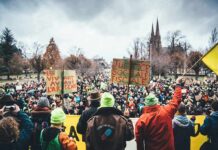

The Berlin Pride attack matters because it sits at the exact point where physical violence, public symbolism, and investigative uncertainty collide: police quickly established that a vehicle had been driven deliberately into a crowd, but the ideological meaning of the act still had to be tested against evidence, not assumed from the target alone.
Key Points
- Police said a vehicle was driven into the Pride crowd deliberately, turning a mass celebration into a crime scene.
- At least one person was killed and 16 others were injured, with some reports describing life-threatening wounds.
- Berlin police said the suspect was known to them as part of the city’s Islamist scene, but they had not yet confirmed motive in the earliest reporting.
- The first hours of coverage contained unsettled details, including the vehicle type, the injury count, and whether the suspect acted alone.
What police established, and what they did not
The core facts were clear within hours. A vehicle struck people gathered for Berlin’s Christopher Street Day Pride event near Tiergarten, one person died, and authorities launched a manhunt after the driver fled or remained at large. Reuters and AP-syndicated reporting said Berlin police treated the ramming as deliberate, which is the essential threshold for a criminal or terrorist investigation rather than a traffic accident. That distinction matters. Deliberateness can be inferred quickly from speed, trajectory, and scene evidence; motive cannot. The first is a matter of reconstruction. The second requires corroboration.
That is why the official wording in the early reporting carries so much weight. Berlin police said they had identified a suspect and that he was known as a member of the local Islamist scene, but the same reports also stated that motive had not been confirmed. In other words, the police were describing an intelligence lead and a possible ideological context, not issuing a final legal classification. A suspect being known to police in an extremist milieu is not the same thing as proving a terrorist offense. It is a lead that can harden into evidence, or collapse if later forensic, digital, or witness material points elsewhere.
Why the Islamist-scene attribution drew immediate attention
The Islamist-scene reference was not a rumor invented by social media; it came from police spokespeople and was repeated by AP, Reuters-syndicated outlets, the Telegraph, Ynet, and others. That repetition matters because it shows the claim originated in an official channel, not in a loose online chain. It also explains the speed with which the incident was interpreted through the lens of political extremism. A Pride parade is a highly symbolic target, and attacks on public celebrations are routinely scanned for motive the moment the basic facts of the assault are understood.
Still, readers should keep the analytical order straight. A Pride event is not proof of anti-LGBTQ ideology any more than a synagogue is proof of antisemitism or a market square is proof of anti-state intent. Target selection can be suggestive; it is not dispositive. The real burden in cases like this is to establish whether the suspect selected the event for ideological reasons, communicated a political or religious grievance, affiliated with an extremist network, or acted from some other motive. Those answers usually come from phones, messages, witness statements, prior police records, and forensic reconstruction of the attack path.
Why the first-hour record was messy
Early reporting rarely arrives as a polished file. It arrives as fragments. In this case, outlets differed on whether the vehicle was a car or van, on the exact number of injured, and on whether more than one suspect was involved. That kind of variability is not unusual in a fast-moving scene, but it does impose discipline on interpretation. When the basic casualty count and vehicle description are still shifting, any stronger claim about motive deserves special caution. The Telegraph explicitly noted there was no immediate confirmation that the incident was terror-related, and other reports likewise stressed that police had not yet identified motive.
That uncertainty is not exculpatory; it is procedural. Investigators often know quickly that an attack was intentional and much more slowly why it happened. In a vehicle-ramming case, the evidentiary sequence usually runs from scene reconstruction to suspect identification to motive testing. Berlin’s early reports followed that pattern. Police could say a manhunt was underway and that a suspect was known to the Islamist scene. They could not yet say, on the record provided, that they had proven a terrorist attack in the legal or operational sense.
How to read the broader significance without overreading the evidence
The broader significance of this case lies in how public fear, media velocity, and investigative caution interact. A mass-casualty attack at a celebratory public event is emotionally legible from the first minute, which is precisely why early narratives harden so quickly. But the presence of a symbolic target does not license a shortcut to motive. The strongest reading of the available record is narrower and more careful: Berlin police believed they had a suspect linked to Islamist circles; they also treated the ramming as deliberate; and they were still working to establish whether ideology actually drove the act.
That is the proper resting point until formal case materials become available. The decisive documents would be the arrest warrant, charging papers, prosecutor statements, or any court filing that identifies the legal theory of the case. Short of that, the evidence supports an authoritative but limited conclusion: this was a deliberate vehicle assault on a Pride crowd, one that police quickly associated with an Islamist milieu, yet not one whose motive was fully proven in the initial record.
German police hunt suspect in Berlin Pride van-ramming attack that left 1 dead and 16 injured https://t.co/nKf5nnlQwJ
— CTV National News (@CTVNationalNews) July 26, 2026
What would resolve the remaining questions
The unanswered questions are not mysterious; they are the ordinary ones that separate suspicion from proof. Did the suspect act alone or with an accomplice? Was there a digital trail showing planning or ideological messaging? Did prior police contact amount to routine watch-list familiarity or to a documented extremist history? And did the route, speed, and final stop of the vehicle show purposeful targeting of pedestrians rather than panic or impairment? Those are the issues that future reporting, prosecutors, and court records would have to settle. Until then, the public record supports the deliberate-assault finding more firmly than it supports any final judgment about motive.
Sources:
facebook.com, youtube.com, smh.com.au, en.wikipedia.org, thesun.co.uk, malaymail.com, rt.com, kob.com, ynetnews.com, x.com