
When a driver with a long history of dangerous behavior allegedly uses his vehicle as a weapon against a vulnerable road user, it exposes not only one man’s pattern of recklessness but a broader failure to keep repeat offenders off Texas roads.
At a Glance
- Authorities say Charles Eric Medina stopped, reversed, and accelerated into professional boxer and cyclist Hannah Rapp, killing her and leading to a manslaughter charge.
- Physical evidence from the crash scene—skid marks, crushed rear hatch, shattered rear window—contradicts Medina’s claim that he backed up slowly.
- Jail and arrest records show Medina has been in and out of Brazos County custody repeatedly since 2012 on charges including deadly conduct, reckless driving, hit-and-run, and assault.
- Rapp’s death illustrates a wider trend: rising cyclist fatalities in Texas, where aggressive driving and road rage increasingly turn vehicles into lethal instruments.
- The case raises hard questions about how many chances a repeat dangerous driver receives before the system intervenes decisively—and whether current tools are enough to protect cyclists.
The Fatal Encounter on FM 159
On a summer morning on FM 159 in Brazos County, 26‑year‑old featherweight boxer Hannah Rapp was riding her bicycle with her boyfriend on a rural stretch of road when they encountered a speeding driver, 31‑year‑old Charles Eric Medina. Investigators say Medina drove past the two cyclists at close range, then chose to escalate the interaction rather than simply continue on. According to a probable cause affidavit from the Brazos County Sheriff’s Office, Medina abruptly slammed on his brakes, skidded to a stop in the roadway, shifted his vehicle into reverse, and rapidly accelerated backward into Rapp, knocking her to the ground.
First responders found Rapp lying in the roadway with severe injuries; she was transported to a nearby hospital, where she was pronounced dead. The rear hatch of Medina’s vehicle was crushed inward, and the rear window was completely shattered—damage consistent with a substantial impact rather than a low‑speed bump. Investigators documented two distinct sets of skid marks: one from Medina’s hard braking as he stopped ahead of the cyclists, and another from his reversing maneuver, with the latter pattern indicating the driver was steering toward an object while backing up. The affidavit concludes that the physical evidence at the scene, combined with Rapp’s final resting position, points to a heavy, directed impact.
Medina’s Account Versus the Physical Evidence
Medina has offered a markedly different narrative of what happened, one that casts the encounter as a misunderstanding rather than an act of road rage. He told authorities he believed Rapp and her boyfriend were attempting to flag him down, prompting him to skid to a stop and reverse toward them. Medina claimed he did not see Rapp until immediately before the collision and insisted he was reversing slowly—around 15 miles per hour—to speak with them.
Investigators, however, view the physical record as incompatible with that description. The crushed hatch and shattered rear window suggest Rapp’s body struck the rear of the vehicle with significant force. Dual sets of skid marks indicate both sudden braking and purposeful reversing, with the reverse marks showing steering input aimed toward a target behind the car. In the Sheriff’s Office affidavit, investigators explicitly state that the damage pattern and Rapp’s final position do not align with Medina’s low‑speed account, instead supporting the conclusion that he accelerated backward into her at a much higher speed.
That evidentiary clash is central to the manslaughter charge. Texas law distinguishes between a tragic accident and criminally reckless conduct; when investigators believe a driver consciously engages in a dangerous maneuver—like backing a vehicle at speed toward cyclists after a confrontation—the case moves out of the realm of negligence and into criminal territory.
A Career Criminal Behind the Wheel
Rapp’s death did not occur in a vacuum, nor was Medina an unknown quantity to local law enforcement. Public reporting on Brazos County jail and court records shows Medina has been arrested in the county at least a dozen times since 2012, with a cluster of charges that point repeatedly to dangerous conduct behind the wheel and a willingness to disregard others’ safety.
Prior cases include deadly conduct and reckless driving, hit‑and‑run, speeding, criminal mischief, and assault causing bodily injury, as well as evading arrest and discharging a firearm. One local report describes a recent incident in which multiple law enforcement agencies responded to complaints of a reckless driver on State Highway 6; Medina was ultimately arrested on charges of deadly conduct and reckless driving. Taken together, this record reveals a pattern: repeated serious offenses, many involving a vehicle, and recurring contact with law enforcement rather than a single isolated mistake.
For people in Rapp’s circle, that history is not an abstract data point. Her coach, Carl Perry, has voiced blunt frustration with the justice system, arguing that if Texas authorities had imposed more effective consequences on Medina earlier, “this beautiful soul of Hannah would still be here with us.” It is a sentiment shared widely in community reactions and on social media, where residents have circulated details of Medina’s arrests and questioned how someone with that record remained on the road long enough to kill a cyclist.
Hannah Rapp: An Athlete and Professional, Not Just a Statistic
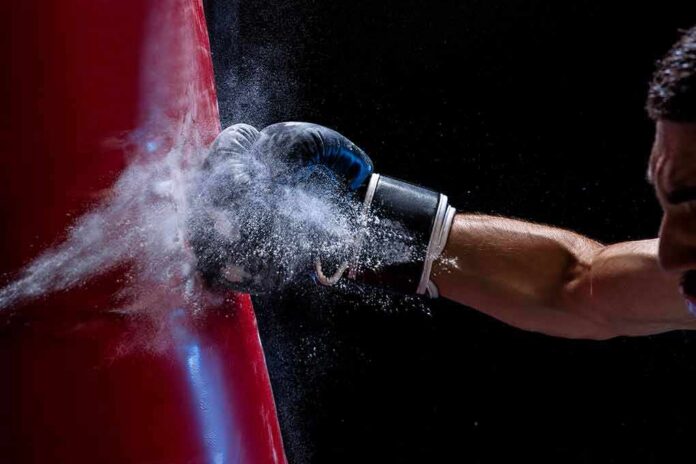
To understand what was lost on FM 159, one has to look beyond the crash report. Hannah “Hanarchy” Rapp was a rising featherweight contender, a North American Boxing Federation champion with a professional record of five wins, one loss, and one draw over seven fights in two years. She was known for her work ethic, resilience in the ring, and a style that combined technical discipline with relentless pressure, earning her a growing following in women’s boxing.
Outside the ring, Rapp worked as an environmental health and safety specialist at Texas A&M University, a role that involves ensuring laboratories, workplaces, and campuses meet safety standards and protect staff and students from hazards. Colleagues and friends have described her as meticulous, conscientious, and deeply committed to both her athletic career and her professional responsibilities. In the days after her death, Texas A&M acknowledged the loss and announced a candlelight vigil to honor her life, drawing students, faculty, and members of the local sports community.
Rapp’s story underscores a point often missed in discussions of traffic violence: the victims are not anonymous “cyclists” or “pedestrians,” but people with layered lives, careers, and relationships. When an encounter with an aggressive driver turns fatal, families and communities lose far more than a number in a crash database.
Road Rage, Aggressive Driving, and the Texas Legal Landscape
Legally and practically, the Medina case sits at the intersection of aggressive driving and road rage. Traffic safety experts differentiate the two: aggressive driving describes unsafe maneuvers like speeding, tailgating, or weaving through traffic; road rage involves intentional hostile acts, such as ramming another vehicle, forcing someone off the road, or stopping to confront and threaten another road user. In Texas, when a driver’s conduct crosses that line—especially when a vehicle is used as a weapon—the consequences move beyond traffic citations to criminal charges and, in civil cases, potential punitive damages.
Using a vehicle as a weapon is precisely how many observers interpret Medina’s alleged actions. Passing two cyclists too closely, then stopping, skidding, reversing at speed, and steering into one of them after a confrontation fits squarely within the definition of road rage behavior that can trigger criminal liability. It also highlights how quickly a moment of anger or perceived slight on the road can escalate into life‑altering violence when the person behind the wheel has both poor impulse control and a history of weapons‑grade negligence.
A Broader Pattern: Cyclist Fatalities and Vulnerability in Texas
Rapp’s death is part of a larger, troubling pattern. Texas consistently ranks near the top nationally in road fatalities, with thousands of deaths annually and a significant share involving vulnerable road users. Federal data show that speeding contributes to roughly a quarter of Texas traffic deaths, while pedestrian incidents account for about 17.5%; cyclist fatalities, though smaller in absolute numbers, have been climbing.
State and regional reports document that in 2024 Texas roadways saw 80 cyclist fatalities, alongside 772 pedestrian deaths. By early 2025, there had already been hundreds of incidents involving cyclists statewide, resulting in dozens of additional deaths. In East Texas specifically, cyclist fatalities quadrupled year‑over‑year according to TxDOT district statistics, signaling that the danger is not confined to major metro areas. Over a decade, crash data indicate tens of thousands of collisions involving pedal cyclists, with nearly 4,000 resulting in fatalities or serious injuries.
Against that backdrop, Rapp’s death is tragically unsurprising. Rural roads like FM 159 often lack shoulders, bike lanes, or robust traffic calming, leaving cyclists exposed to speeding vehicles and drivers who may view them as obstacles rather than legitimate road users. TxDOT’s own safety campaigns urge drivers to yield to cyclists, pass at a safe distance, and treat them as entitled to the lane; the gap between that guidance and day‑to‑day behavior is where cases like Medina’s emerge.
How has Charles Eric Medina been in and out of jail in Brazos County 12 times?? He just killed a female bike rider. Now he is only charged with manslaughter?? What is going on in Brazos County Texas?@GregAbbott_TX @DanPatrick @KenPaxtonTX https://t.co/E5hZHwDtLw
— Kim Ashley 🇺🇸 🇮🇱 (@texaskat2003) July 20, 2026
Systemic Questions: Repeat Offenders and Public Safety
When a driver with Medina’s record is accused of killing a cyclist in a manner investigators describe as both intentional and reckless, it prompts uncomfortable questions about systemic performance. Texas law enforcement and courts had multiple prior opportunities to assess his risk to the public—through charges for deadly conduct, reckless driving, and related offenses—and to impose sanctions strong enough to deter or incapacitate him. Yet by mid‑2026 he remained licensed and mobile, driving fast on a rural road where cyclists were present.
There are structural reasons for this. Traffic‑related criminal cases often result in plea deals, probation, or relatively short local jail stays, particularly when prior incidents did not produce serious injury. Courts balance crowded dockets, limited jail capacity, and statutes that treat many dangerous behaviors as misdemeanors unless and until someone is seriously hurt or killed. That framework inevitably leaves some high‑risk drivers on the road.
The Medina case therefore becomes more than a narrative about one man and one victim; it is a stress test for how well Texas’s existing tools identify and respond to serial dangerous drivers before tragedy occurs. For cyclists and pedestrians, the answer, in this instance, looks bleak.
What This Means for Cyclists and Communities
For everyday Texans who walk or ride, the lessons from Hannah Rapp’s death are sobering. Defensive riding, lights, helmets, and adherence to traffic laws all matter—but they cannot fully protect a cyclist from a driver willing to weaponize a vehicle. The most effective protections are upstream: enforcement against repeat reckless drivers, meaningful consequences for deadly conduct, and infrastructure that slows vehicles and separates them from vulnerable users.
Communities around College Station and Navasota have responded with grief and anger, but also with calls for greater accountability. Some of that pressure is directed at Medina personally; some is focused on the institutions that repeatedly processed him and then returned him to the road. For many, the ultimate measure of justice in this case will not be the manslaughter trial alone, but whether Rapp’s death prompts any durable changes in how Texas handles chronic dangerous drivers and invests in cyclist safety.
Sources:
nypost.com, cbsnews.com, youtube.com, wtaw.com, newsbreak.com, kbtx.com, dshs.texas.gov, kltv.com, mlflegal.com, wfaa.com, tmcec.com, txdot.gov, pmc.ncbi.nlm.nih.gov