
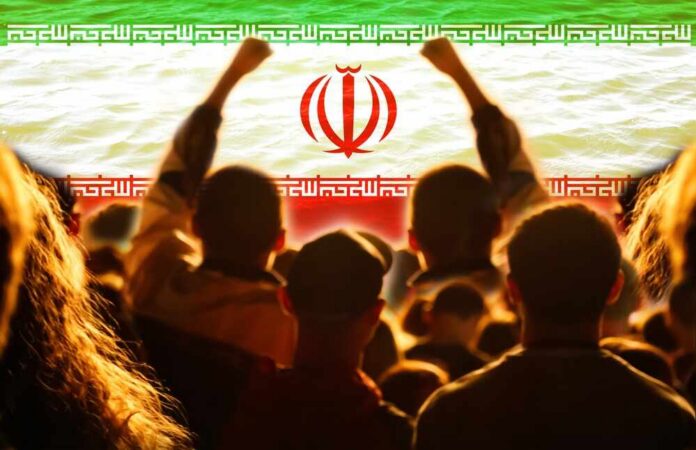
Khamenei’s funeral procession through Iraq’s shrine cities is not just a display of mass grief; it is a meticulously engineered ritual that fuses devotional practice with a calibrated projection of Iranian–Iraqi Shia power.
At a Glance
- Iraq has orchestrated a three-stage funeral plan in Najaf and Karbala, integrating the procession into its existing Arbaeen pilgrimage infrastructure.
- Tens of thousands of Iraqi security and service personnel, including 20,000 Popular Mobilization Forces (PMF) members, have been mobilized to manage the crowds and protect the event.
- The ceremony routes and welfare services are planned in granular detail, reflecting how modern Shia state funerals operate as large-scale logistical and political operations.
- Global media frames the funeral simultaneously as genuine mourning and as “geopolitics of grief,” highlighting the tension between religious devotion and strategic messaging.
A Funeral Engineered on a Pilgrimage Scale
The Iraqi segment of Ayatollah Ali Khamenei’s funeral is built on a structure that the country’s authorities know well: the annually recurring Arbaeen pilgrimage to Karbala, which has turned Iraq into the stage for some of the largest religious gatherings in the world. Well before the coffin reached Najaf, Prime Minister Ali al-Zaidi issued an executive order assigning the same committee that manages Arbaeen to run the funeral operation, effectively slotting this extraordinary event into an existing, battle-tested institutional machine.
That decision explains the precision of the Iraqi plan. Officials describe a three-stage process: arrival and formal reception at Najaf International Airport; a public procession and rites at the shrine of Imam Ali in Najaf; and a transfer to Karbala for ceremonies at the shrines of Imam Hussein and Abbas before the body returns to Iran for burial in Mashhad. Timelines, from a one-hour official reception at Najaf to evening ceremonies in Karbala, are specified down to the hour. What looks, from outside, like spontaneous outpouring is in practice the product of detailed operational design.
Security, Services, and the PMF’s Visible Role
The numbers attached to this operation highlight its scale. Iraqi and PMF officials state that 20,000 PMF personnel have been formally allocated to secure the Najaf segment alone, in coordination with the Joint Operations Command and local governments. This is not peripheral crowd control; it is a full deployment of a major paramilitary institution into a religious ritual space. In parallel, Iraqi authorities and the funeral committee have arranged hundreds of service stations—mawakib—351 in Najaf and more than 400 in Karbala, to distribute water, food, and basic aid to mourners along the route. The health infrastructure mirrors that ambition: 150 ambulances have been positioned along the funeral routes in both cities to respond to medical incidents in high heat and dense crowds.
These arrangements tell us two things about contemporary Iraqi governance. First, the state has learned, sometimes through tragedy, that mass pilgrimages are high-risk events requiring sophisticated traffic, security, and medical planning. Second, the PMF is now embedded in that architecture. Born as militias during the war against ISIS, the PMF today appears as an institutionalized guardian of Shia ritual life, managing everything from security grids to flag-lined corridors bearing the colors of Iran, Iraq, and Hezbollah. That visibility is politically charged: it visually ties Khamenei’s memory to the transnational Shia militant networks he helped sponsor.
Routes, Ritual Geography, and Symbolic Stakes
The choice of Najaf and Karbala is not incidental. In Shia Islam, Najaf—home to the shrine of Imam Ali—and Karbala—site of Imam Hussein’s martyrdom—anchor a geography of sacrifice and authority. Iraqi committee officials detail that the Najaf funeral route spans roughly six kilometers, from Mojsarat al-Sadrain to the Imam Ali shrine, while the Karbala procession covers about 5.8 kilometers through the city’s shrine zone. These are not random paths; they trace recognizable pilgrimage corridors that millions traverse each year during Arbaeen and other observances.
Local testimony underscores the weight of that symbolism. DRM News’ reporting captures Karbala residents describing their participation as a “sacred duty,” arguing that Khamenei “sacrificed himself for Islam, not just for the Shiites, but for all of Islam.” The governor of Karbala has declared a public holiday to ensure unobstructed conduct of the funeral, effectively subordinating normal civic life to the demands of the ritual. In a region where state calendars often revolve around religious commemorations, such decisions reinforce the idea that Khamenei’s death belongs not just to Iran’s political history but to a wider Shia martyrology.
Crowd Size, Evidence, and the Limits of Measurement
Officials in Iran and Iraq speak confidently of “millions” of mourners, with some projections reaching 12–15 million attendees across the full seven-day procession through multiple cities. For the Iraqi segments, PMF statements on social media claim figures in the low millions. Yet, precise independent verification of those numbers is not available in public sources. Satellite imagery analyses, formal crowd science estimates, or third-party aerial photography—methods that have gradually become standard for assessing major demonstrations—are not cited in the reporting.
What can be stated with confidence is that the funeral events in Iran and the Iraqi shrine cities have drawn very large crowds, visible across multiple video feeds from local and international media, and described by global outlets like the BBC and AP as among the largest public gatherings relative to national population in Iran’s contemporary history. Whether the final tally reaches tens of millions matters less than the political and religious aim of that rhetoric: to demonstrate that Khamenei, despite the controversies of his rule and the manner of his death, commands a vast reservoir of loyalty—or at least mobilizable presence—across the Shia world.
Geopolitics of Grief: Mourning as Power Projection
Commentary from regional analysts has framed the funeral as a textbook case of what one think tank article calls a “political operation to manage succession and project power” through ritualized public mourning. The itinerary—from Tehran and Qom to Najaf, Karbala, and finally Mashhad—forms what Amwaj Media terms a “geopolitics of grief,” an arc of ceremonies that visually and emotionally links Iran’s theocratic center to transnational Shia networks anchored in Iraq.
Iraq’s new government is an integral actor in that choreography. Hosting part of the funeral affirms Baghdad’s alignment with Tehran at a moment of heightened confrontation between Iran and the United States–Israel alliance. The presence of Iraqi presidents, prime ministers, senior Shia, Sunni, and Kurdish leaders, and religious figures at Najaf’s airport reception, as reported by regional media, conveys an image of cross-sectarian state endorsement, even as many non-Shia Arab governments remain silent. In effect, the funeral becomes a platform on which Iran’s leadership transition is publicly blessed by Iraq’s political class, projecting continuity of the axis that has shaped regional conflicts for two decades.
Media Narratives: Devotion, Defiance, and Distance
Coverage splits along familiar lines. Iranian state outlets emphasize martyrdom, unity, and religious devotion, largely suppressing dissenting views and presenting the funeral as a universally embraced moment in the Islamic world. International broadcasters and Western press, by contrast, weave the ceremonies into the broader narrative of war with the United States and Israel, treating the procession as both a memorial and a show of political defiance. Headlines speak of “huge crowds” and “massive funeral processions,” but frame them within geopolitical stakes—succession in Tehran, the future of the nuclear file, and proxy conflicts stretching from Lebanon to Yemen.
That framing does not dispute the core facts of the funeral itself; Reuters, AP, BBC, and others treat the ceremonies and the large crowds as an uncontested reality. Where it diverges from Iranian and Iraqi official narratives is in assigning meaning. For mourners on the ground, as their own statements suggest, the focus is on spiritual obligation and communal identity. For foreign audiences, the funeral is read primarily as a message: that Iran’s project survives its leader, that its networks can still summon massive displays of support, and that a new supreme leader will inherit not just institutions but a powerful myth of martyrdom.
Mourners marched through Iraq’s holy city of Najaf on Wednesday, following the coffin of slain Iranian leader Ayatollah Ali Khamenei as his six-day funeral procession pressed on across the border.https://t.co/aHvxZWgT25#Iran #Najaf #MiddleEast #Iraq #brecordernews
— Business Recorder (@brecorder_com) July 8, 2026
Continuity with a Longer History of Shia Political Funerals
Khamenei’s funeral in Iraq sits in continuity with earlier episodes in which Shia funerals doubled as political theatre. The 2006 funeral of Grand Ayatollah Muhammad Baqir al-Hakim in Najaf, for instance, saw Iranian-backed militias use the procession to signal their dominance during the U.S. occupation, prompting Western commentators to label the event a “political show” as much as a spiritual rite. Similarly, the 2020 funeral marches in Iraq for Iranian General Qassem Soleimani and PMF commander Abu Mahdi al-Muhandis mobilized huge crowds whose chants and imagery openly targeted U.S. presence in the country.
In this lineage, funerals operate as transitional rituals: they help manage leadership succession, reaffirm alliances, and re-inscribe narratives of resistance on the urban and sacred landscape. Khamenei’s coffin passing through Najaf and Karbala signals that his authority was never confined to Iran’s borders; it was anchored in a broader Shia cosmology that uses these cities as symbolic capitals. For Iraq’s ruling actors, hosting those rites is both a concession to that transnational religious identity and a statement that they, too, sit at the center of the Shia world’s political future.
What This Means Going Forward
Seen in full, the Iraqi funeral procession for Khamenei is less a singular spectacle than a template. It demonstrates how contemporary Shia-led states orchestrate mass mourning as a form of governance: they mobilize paramilitary forces as custodians of ritual, deploy welfare and health infrastructures as instruments of legitimation, and choreograph routes through shrine cities to narrate continuity between past martyrs and present leaders. It also shows how those same rituals are inevitably read through geopolitical lenses by external observers, who focus on the strategic implications of crowds and flags more than on the inner logic of grief.
For readers trying to understand Iraq’s and Iran’s trajectory after Khamenei, the key is not to choose between “genuine mourning” and “geopolitical maneuver” as mutually exclusive explanations. The evidence supports both. The thousands who line the streets of Najaf and Karbala are acting out deeply rooted religious commitments; the states that organize and frame those gatherings are simultaneously using them to signal power, manage succession, and remind rivals that, even in death, their leaders can command a formidable presence across borders. In the contemporary Middle East, this fusion of piety and politics is not an anomaly—it is the operating system.
Sources:
youtube.com, presstv.ir, en.mehrnews.com, wvtf.org, facebook.com, instagram.com, bbc.com, niacouncil.org, aljazeera.com