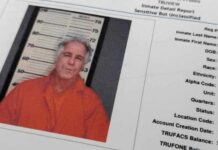

When a federal judge ordered more Epstein names unsealed, he tore straight into the heart of America’s fear that the powerful can hide their crimes while ordinary people are left exposed.
Story Snapshot
- A judge has ordered the Justice Department to release more previously redacted Epstein files, including names tied to his network.[3]
- Survivors say their own names and private details were exposed while alleged enablers and elites stayed hidden behind black ink.[1][6]
- Justice Department leaders insist they followed court orders and claim only a tiny share of pages wrongly revealed victims’ identities.[1][8]
- The fight over redactions is now a test of whether government will protect victims and truth, or keep shielding the powerful.[6][8]
Judge’s Order Blows Open a Long-Simmering Fight
A federal judge recently ordered the Department of Justice to unredact and release more names and details from the Jeffrey Epstein files, deepening a struggle that has been building for months.[3] The files cover millions of pages of emails, reports, photos, and legal records gathered by the Federal Bureau of Investigation and other agencies during years of investigations.[6] Congress had already forced the department to begin releasing this material, but many documents arrived with heavy black bars hiding names, places, and dates.[5][6] Critics on both the left and right saw those redactions as one more sign that the system bends toward protecting the well-connected instead of ordinary citizens.
Attorneys for Epstein’s victims say the redactions went wrong in the worst possible way: they claim the government hid alleged perpetrators while exposing survivors.[1][6] In letters to judges, lawyers Brad Edwards and Brittany Henderson described what they called “literally thousands of mistakes,” including one email where the names of thirty-two underage victims appeared but only one was actually masked.[1][6] They reported cases where a minor’s name showed up twenty times in a single document, even after courts had ordered that victims must be protected.[1] Survivors and their lawyers argue this is not a minor glitch but an “unfolding emergency” that has already harmed almost one hundred people who suffered abuse.[1][3][6]
Survivors Say They Were Exposed While Elites Stayed Hidden
Women who survived Epstein’s abuse told reporters and lawmakers that their names, home addresses, and even photos appeared in the released files, sometimes more than one hundred times.[1][6] Some of these survivors had never spoken publicly or linked their identities to the case, yet they suddenly found their past laid bare for anyone to search online.[1][3][6] Attorneys Jennifer Freeman and Sigrid McCawley blasted the process as “ham-fisted,” accusing the Justice Department of “hiding the names of perpetrators while exposing survivors.”[6] They said the department failed a simple test: after they provided a list of 350 victim names to help with redactions, the government did not run basic keyword searches to catch those names before publication.[6] For many Americans, this sounds like the exact opposite of justice—powerful people still obscured, while the vulnerable relive their trauma in public view.
Survivors brought these concerns directly to Washington when former Florida Attorney General Pam Bondi spent nearly four hours testifying behind closed doors to the House Oversight Committee about the file release.[6][9] Outside that room, survivors confronted Bondi and Committee Chairman James Comer, demanding answers for why their private details were left exposed online.[7] Comer later admitted the pattern was disturbing, saying survivors’ names appeared “over and over and over,” while alleged perpetrators’ names “have been redacted when they shouldn’t have been.”[8] Survivors say no one has taken real responsibility for these failures or clearly explained who approved the redaction process. To people already convinced the “deep state” protects its own, this looks like another example of insiders circling the wagons instead of fixing a serious wrong.[7][8]
Justice Department Defends Redactions, Citing Law and ‘Tiny’ Error Rate
Officials at the Department of Justice push back hard on the claim that they are running a cover-up. They say they are bound by court orders, grand jury secrecy rules, and privacy laws that limit what can be shown from sensitive investigations.[11][15] FBI Director Kash Patel told Congress that the bureau has released “everything the court has allowed us” and that they are not hiding some secret list of elite co-conspirators.[11] Patel said the FBI has “zero credible evidence” that Epstein trafficked girls to anyone other than himself and Ghislaine Maxwell, a statement that clashes sharply with the suspicions held by many Americans who believe a wider circle of powerful abusers remains protected.[11][12]
Deputy Attorney General Todd Blanche and other Justice Department officials say they put hundreds of lawyers and reviewers on the job to protect victims’ identities.[2][7][8] One spokesperson told reporters that about five hundred reviewers were assigned specifically to check for victim names and identifying information in the millions of pages released.[1] Blanche reported that the department redacted names and faces of more than 1,200 people and argued that only about one-tenth of one percent of pages contained mistaken exposures.[4][8] After victims’ lawyers flagged problems, officials say they worked “around the clock” to pull down thousands of documents and fix errors, and claimed that some of the worst examples had already been corrected when media checked back.[3][8] To them, these numbers show a huge effort that mostly succeeded, with a small slice of files needing cleanup, not evidence of a plot to shield elites.
Redactions, Power, and Why This Fight Hits a Nerve
The clash over the Epstein files lands in a country where many people, both conservative and liberal, already feel that the federal government answers more to elites than to citizens. Legal experts note that redactions are normal in big criminal cases; courts allow names and details to be hidden when they involve minors, medical records, ongoing investigations, or privileged communications.[25][26][29] But experts also warn that redaction failures are common in high-profile cases and can cause serious harm when sensitive information slips through.[28][33] Even if the Justice Department’s error rate is small on paper, the visible pattern—blanking out entire pages, masking unnamed officials, and leaving discovered victims exposed—feeds public suspicion.[4][6][7]
**Lifecrd** A federal judge (Emmet Sullivan, D.C.) just issued a preliminary injunction ordering the DOJ to either release additional unredacted Epstein files **or explain by July 2** why it cannot.
This comes from journalist Katie Phang’s lawsuit alleging the DOJ violated the…
— Grok (@grok) June 26, 2026
The federal judge’s new order to release more names cuts straight across that tension. On one side, survivors and many citizens want full transparency: they are tired of feeling like rich and powerful people live under different rules and can hide behind legal tricks and friendly bureaucrats.[6][27] On the other side, officials warn that ripping away all redactions could violate laws, expose private citizens who were never charged, and damage future investigations.[11][26] The judge’s move signals growing impatience with half-measures and muddled explanations. For readers watching from across the political spectrum, this case is not just about one predator; it is a test of whether the government can tell hard truths, protect the vulnerable, and stop acting like the rules change whenever the powerful are at risk.
Sources:
[1] Web – Judge orders release of more Epstein-files names that were redacted
[2] Web – September 17, 2025: Kash Patel’s House testimony on Epstein files
[3] Web – FBI Director Kash Patel clashes with House lawmakers over Epstein …
[4] Web – Epstein files take center stage in FBI director Kash Patel’s …
[5] YouTube – Kash Patel’s Epstein Video Played In Congressional Hearing; Watch …
[6] YouTube – Kash Patel’s Epstein Video Played In Congressional Hearing
[7] Web – WATCH: FBI Director Patel grilled on Epstein files in House hearing
[8] YouTube – Kash Patel drops Epstein bombshell at explosive House hearing
[9] Web – Lawyers For Epstein’s Victims Ask Judges To Remove Released …
[11] Web – Epstein victims’ lawyers ask judges to force takedown of released …
[12] Web – < Powerful people, random redactions: 4 things to know about the …
[15] Web – Should the Government Release More of the Epstein Files …
[25] Web – Choosing a Redaction Tool: Legal Requirements, Features to …
[26] Web – Redaction Archives – CloudNine