
The most important thing to understand about Iranian military threats against American forces is that they are rarely bluster in the purest sense and rarely proof of unstoppable reach either — they sit in a well-documented middle ground where rhetoric anticipates capability, and capability sometimes, but not always, catches up to rhetoric.
Key Points
- Iranian armed forces spokesman Abolfazl Shekarchi has repeatedly and specifically threatened that no location — hotels, resorts, tourist sites — is safe for U.S. and Israeli personnel, in statements corroborated across more than a dozen independent outlets.
- The record shows actual Iranian strikes on U.S.-linked bases in Jordan, Kuwait, Bahrain, and Iraq, with American casualties, lending real weight to a warning that could otherwise be dismissed as propaganda.
- Washington’s public response frames each incident as a discrete act of self-defense and deterrence rather than conceding the sweeping “no safe place” narrative — but it has not directly rebutted the specific hotel and civilian-lodging threat.
- This is not a new pattern: Iranian leaders have warned for decades that the region will no longer “shield” U.S. bases, a rhetorical strategy that long predates the current escalation.
- The practical takeaway for anyone tracking the conflict is to separate the psychological-warfare function of these threats from the narrower, verifiable record of where Iranian ordnance has actually landed.
The Warning and Its Escalating Specificity
Shekarchi’s language has hardened over successive statements rather than remaining static, which is itself diagnostic. In late February he warned that any conflict would lead to the “destruction” of U.S. troops and equipment in the region. Within weeks the claim widened geographically: “any place and any territorial point sheltering the interests of the United States” became a target, and by March he was telling Iranian state television that hotels housing American forces “become American” in Iran’s targeting logic — “we have to strike wherever they are”. By late March the threat had expanded again, this time to civilian recreational space worldwide: parks, resorts, and tourist destinations.
This progression matters because military spokesmen calibrate threats to signal intent without over-committing to specifics that could later be falsified. The shift from battlefield language to civilian-adjacent language — hotels, resorts, “recreational and tourist locations around the world” — reads less like a single outburst and more like a deliberate broadening of the deterrent aperture, consistent with Iran’s own military doctrine of asymmetric, psychologically-weighted signaling against a conventionally superior adversary.
From Rhetoric to Record: What Actually Happened
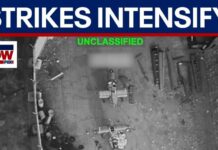
Unlike many wartime threats that never leave the realm of the podium, this one has a body of corroborating incidents behind it. Iranian missile and drone strikes hit U.S.-linked bases in Kuwait, Bahrain, and Jordan, with Kuwait’s electricity ministry reporting repeated strikes on a power and desalination plant. American service members were killed in a Jordan base attack, and CENTCOM documented a self-defense strike following the downing of a U.S. Army Apache helicopter. Reporting also indicated that American personnel had, at points, been relocated into hotels and office buildings as bases came under sustained attack — and that Iranian-backed militias in Iraq subsequently targeted hotels known to house American personnel, a detail that lends the “hotel” warning unusual specificity rather than treating it as rhetorical excess.
None of this proves Iran can strike anywhere on earth at will, as the most maximalist reading of “no safe place” would suggest. But it does mean the warning cannot be waved off as empty theater. The gap between the two readings — total omnipresent threat versus a real, if geographically bounded, capacity to hit forward-deployed U.S. and allied assets — is precisely where the honest analysis has to sit.
How Washington Frames the Same Events
The U.S. government has not, on the public record, directly rebutted Shekarchi’s hotel-specific or resort-specific claims line by line. Instead, American statements consistently narrow the frame to individual incidents and to the language of collective self-defense: the State Department has described U.S. operations as acting in that legal posture and states that forces are “positioned and prepared” to protect personnel, while CENTCOM’s public releases describe completed strikes as responses to specific Iranian attacks rather than acknowledgments of an unbounded threat. Reuters reported that the U.S. withdrew some personnel from bases as a precaution after Iranian retaliation warnings — a measure that treats the risk as manageable and contingent, not as proof troops have nowhere safe to go.
This is a meaningful distinction in tone, but it is not the same as evidence disproving the Iranian claim. The U.S. posture communicates resolve and procedural control; it does not supply a declassified assessment of Iranian targeting precision or reach that would let outside observers judge whether “no safe place” is closer to accurate or closer to exaggerated. That asymmetry — vivid, quotable Iranian threats against comparatively dry, procedural American statements — shapes how the story gets covered, and it tends to favor the more dramatic framing in headlines even when the underlying U.S. position is institutionally cautious rather than dismissive.
𝗠𝗜𝗗𝗗𝗟𝗘 𝗘𝗔𝗦𝗧 𝗨𝗣𝗗𝗔𝗧𝗘 — ☀️ MORNING INTELLIGENCE BRIEF 22/07/2026
🔴 Conflict signal: 9/10
Night-11 US strikes hit Iran's largest gas refinery while Iranian ballistic missiles reached Jordan's civilian port of Aqaba — the conflict's widest geographic footprint…
— QD | Middle-East Research | NFA DYOR (@QuantiaOnPoly) July 22, 2026
The Deeper Pattern: Four Decades of the Same Message
None of this is unprecedented. Iranian leadership has invoked variations of “no safe haven” language since well before the current conflict. Brookings has documented Ayatollah-level statements that the United States would no longer have “a safe haven for its mischief and for establishing military bases,” and that regional states would “no longer serve as shields for American bases”. The Middle East Institute has tracked a sustained Iranian campaign to oust the U.S. military from the region using proxies and rhetoric together, while the Foundation for Defense of Democracies and the American Jewish Committee both catalog a continuous record of Iranian and Iranian-backed attacks on Americans stretching back to 1979. Read against that history, Shekarchi’s statements are not a rupture — they are the latest iteration of a strategy Tehran has run for generations: combine calibrated, deniable-enough violence with maximalist public rhetoric, betting that the psychological effect outlasts any single strike’s actual military value.
What This Means Going Forward
The durable lesson here isn’t about this particular spokesman or this particular news cycle — it’s about how to read Iranian military statements generally. Treat the rhetoric as a genuine signal of intent and of Iran’s strategic posture, because the historical record shows Tehran usually acts in the direction its spokesmen threaten, even if imperfectly and at reduced scale. But don’t treat the rhetoric as a verified technical claim about targeting capability, because the U.S. side has neither confirmed nor been forced to confirm the full extent of that reach, and independent, incident-level verification remains thin. The responsible reading sits between credulity and dismissal: American installations and personnel in the region face a real, demonstrated threat; a literal claim that literally nowhere on the planet is safe remains, for now, unproven and unlikely to be tested to its full extreme.
Sources:
tass.com, youtube.com, facebook.com, islamtimes.com, iranintl.com, humenglish.com, wanaen.com, en.mehrnews.com, ynetnews.com, cbsnews.com, fdd.org, politico.com