
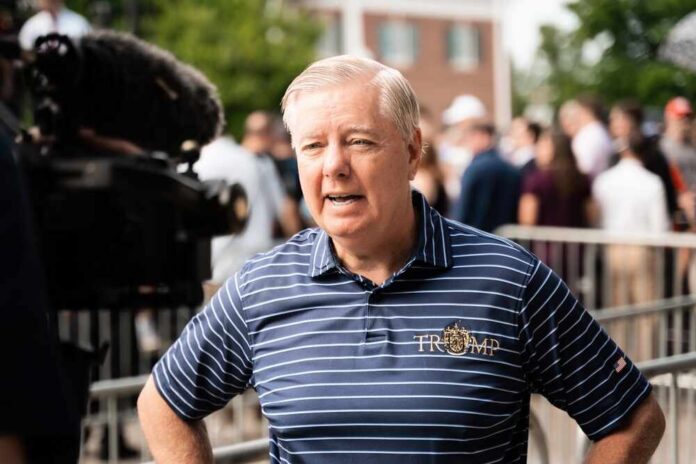
When a powerful senator dies suddenly after confronting foreign adversaries, the human instinct is to look for a hidden hand—but in Lindsey Graham’s case, the evidence points decisively to a catastrophic heart event, not a Russian poison vial.
At a Glance
- Lindsey Graham died at 71 from an aortic dissection linked to longstanding cardiovascular disease, according to the D.C. medical examiner’s preliminary findings.
- Donald Trump, likely Graham’s last substantive phone call, describes the senator as tired but otherwise engaged and focused on legislation in the hours before his death.
- Russia- and Iran-linked poisoning theories have flourished online, but to date no public toxicology, law‑enforcement, or intelligence evidence supports foul play.
- The episode illustrates how sudden high‑profile deaths in a polarized, mistrustful environment reliably generate conspiracy narratives that outpace the facts.
What Is Firmly Established About Graham’s Final Hours and Cause of Death
Lindsey Graham’s death is unusual only in its timing and his prominence, not in its medical character. The senator, 71, died at his Washington, D.C., residence following what his office initially described as a “brief and sudden illness,” after emergency responders were dispatched for cardiac arrest. Within days, the Office of the Medical Examiner for the District of Columbia communicated preliminary findings: Graham suffered an aortic dissection caused by arteriosclerotic cardiovascular disease.
An aortic dissection is an abrupt tear in the inner layer of the aorta—the body’s main artery—that allows blood to force its way between layers of the vessel wall. That process can interrupt blood flow to vital organs, trigger massive internal bleeding, or both. Clinically, it often presents as sudden, severe chest or back pain and can rapidly lead to cardiac arrest. In older adults with long‑standing cardiovascular disease, a dissection is not exotic; it is a known, if relatively infrequent, catastrophic endpoint of chronic arterial damage.
Reporting indicates that Graham had a family history of heart disease; his father died of a heart attack in his late sixties, a pattern that aligns with the medical examiner’s focus on arteriosclerotic disease as the underlying condition. The examiner’s statement, quoted in multiple accounts, explicitly identifies the event as natural and consistent with Graham’s cardiovascular profile. Toxicology and microscopic studies were still pending at the time of those reports, as is standard in sudden deaths, but no official has suggested any deviation from the initial cardiovascular conclusion.
Trump’s Account: A Tired but Active Ally, Not a Man in Obvious Distress
Donald Trump’s narrative of his last conversation with Graham has become central to public understanding of the senator’s final hours. In interviews on NBC’s “Meet the Press,” CBS News, and other outlets, Trump said Graham called him on Saturday evening, shortly after returning from Ukraine, to discuss both foreign policy and domestic legislation.
According to Trump, the call occurred around 6:30–7:00 p.m. and lasted several minutes. Graham was “tired” from travel but otherwise in good spirits, talking energetically about the “Save America Act” and about sanctions on Russia after his Kyiv trip. Trump has repeatedly emphasized that Graham “was fine” apart from fatigue and showed no signs of acute illness during their exchange.
Other reporting fills in the remainder of the evening. After speaking with Trump, Graham reportedly told another confidant that he was feeling unwell but planned to fulfill a scheduled Sunday appearance on “Meet the Press” about Ukraine before seeking medical attention. This is a familiar pattern among driven, high‑status professionals: symptoms are minimized or rationalized until the body makes further decisions impossible. Sometime later that night, Graham’s condition deteriorated rapidly; emergency dispatch audio indicates responders were called for cardiac arrest at his home.
Trump has publicly rejected the poisoning theories, saying in one interview that he believed Graham suffered a heart attack—a layperson’s term for the sudden cardiac event that accompanied the aortic dissection. His recollection aligns with the medical narrative: an older man with known cardiovascular risk factors, exhausted after international travel, ignoring early warning signs, then succumbing to a catastrophic arterial failure.
Russia, Iran, and the Anatomy of an Assassination Theory
Despite the medical examiner’s findings, Graham’s death almost instantly became raw material for online claims that he had been assassinated—poisoned by Russia, Iran, or even Israel’s Mossad. The timing was certainly suggestive to those predisposed to see plots. Graham died less than 24 hours after a high‑profile visit to Kyiv, where he pushed for tougher sanctions on Russia, and days after Iranian officials publicly threatened him over his hawkish commentary on Tehran.
MAGA‑aligned influencers seized on those facts, stitching them into a narrative in which foreign intelligence services exploited Graham’s vulnerability during travel to deliver a fatal toxin. Articles and videos speculated that Russia and Iran had “motive, opportunity and intent” to kill the senator, pointing to the Kremlin’s history of poisoning dissidents and Tehran’s rage at Graham’s calls to “blow Iran off the map.” A prominent critic of Vladimir Putin went so far as to describe the probability of Russian involvement as “very high,” relying largely on timing, Graham’s Ukraine itinerary, and Russia’s known tradecraft.
The narrative grew stranger as it spread. Putin adviser Alexander Dugin suggested Mossad might have orchestrated the killing to push Trump into war with Iran, before reportedly floating an alternate theory blaming Iran itself. Social‑media posts and fringe outlets speculated in multiple directions simultaneously, united only in their insistence that Graham’s death must be an assassination, because a “brief and sudden illness” felt insufficiently dramatic.
Yet across this entire ecosystem of suspicion, one element is conspicuously absent: verifiable, physical evidence. No toxicology report has surfaced with indications of exotic agents. Law‑enforcement officials have not announced any traces of poison or foul play. Preliminary findings from the D.C. medical examiner and statements from authorities point consistently to natural cardiovascular causes.
What the Evidence Actually Says—and Does Not Say
To date, the factual record around Graham’s death rests on several pillars. First, the timeline: Graham returns from Ukraine, appears healthy during public engagements, speaks by phone with Trump about policy battles to come, then experiences a rapid health collapse at home resulting in cardiac arrest. Second, the medical findings: aortic dissection due to arteriosclerotic cardiovascular disease, with emergency dispatch audio confirming responders were told they faced a cardiac event.
Third, official posture: statements from Graham’s office, the medical examiner, and coverage citing law‑enforcement sources consistently characterize the death as natural. Some reports note that the FBI is assisting with the investigation, a routine step when a sitting senator dies unexpectedly, but they underscore that no evidence has emerged linking the death to foul play.
Against this, the poisoning narrative is built almost entirely on inference. Its strongest claims involve motive and capability—Russia and Iran certainly have both, especially given Graham’s loud advocacy on Ukraine and Iran sanctions—but motive and capability are not proof. Writers promoting the theory acknowledge that sudden cardiac arrest is common at Graham’s age, particularly under travel stress, and concede that “no public evidence yet links Graham’s death to foul play.”
One detailed examination of the online theories concludes bluntly that there is “no evidence” for assassination claims and that they have taken hold largely because they fit pre‑existing beliefs in certain political communities. Another video analysis, aimed at decoding the speculation, reiterates that officials have reported a natural cardiovascular cause and that nothing in the public record demonstrates poisoning.
In short: there is a plausible, well‑documented medical explanation grounded in Graham’s age, history, and the physiology of aortic dissection, and there is a speculative geopolitical story that has yet to clear even the lowest evidentiary hurdle.
Why Sudden Political Deaths So Readily Become Conspiracy Fuel
Graham’s case is not an anomaly; it is part of a broader pattern in contemporary political culture. Survey research across all 50 states finds that roughly 78.6 percent of Americans agree with at least one conspiratorial idea on a standard scale, and nearly one in five endorse all four items. That baseline predisposition means that when a prominent figure dies suddenly, large segments of the public are primed to interpret the event as the outcome of secret plots rather than random biology.
High‑profile deaths and violent incidents have repeatedly spawned detailed, evidence‑free theories—from murdered staffers to mass shootings allegedly staged with “crisis actors.” Media‑consumption patterns amplify this tendency: individuals who avoid mainstream news or rely on fragmented, partisan feeds are more likely to believe that malevolent hidden actors control major events. Between 2012 and 2022, the correlation between conspiratorial thinking and support for political violence roughly tripled, underscoring how these narratives can erode democratic norms and increase tolerance for real‑world extremism.
Graham’s death hits multiple triggers at once. He was polarizing, deeply involved in foreign policy, vocal against hostile regimes, and central to the Trump orbit. His passing also coincided with heightened tensions involving Iran and naval traffic in the Strait of Hormuz, giving every rumor a ready‑made geopolitical backdrop. In such a context, a mundane medical report feels almost like a provocation to those emotionally invested in more cinematic explanations.
Trump, Iran, McConnell: The Wider Strategic Context
The swirl of speculation around Graham’s death has unfolded against a larger tableau of Trump’s foreign‑policy messaging and Republican Party dynamics. In interviews following the senator’s passing, Trump repeatedly framed his comments about Iran and ongoing U.S. strikes as constrained by “respect for Lindsey,” even as he insisted the Strait of Hormuz was “open as far as I’m concerned” despite data showing sharp declines in tanker traffic.[MeidasTouch transcript]
At the same time, Mitch McConnell’s extended absence from the Senate due to a fall and pneumonia has raised questions about continuity of Republican leadership. Commentators note that losing Graham—a skilled deal‑maker and foreign‑policy hawk—while McConnell is sidelined complicates Trump’s legislative agenda, from appointments such as Todd Blanche as Attorney General to efforts to advance measures like the “Save America Act.”[MS NOW transcript]
For those inclined toward grand theories, these overlapping developments—Graham’s sudden death, McConnell’s hospitalization, rising tensions with Iran and Russia, Trump’s political and legal vulnerabilities—line up neatly. It is precisely this neatness that should trigger caution. Complex systems rarely operate with such narrative symmetry; more often, they produce messy, overlapping crises driven by ordinary human frailty and institutional drift.
Sen. Lindsey Graham Dies Suddenly at 71; Sister Appointed to Finish His Term
Longtime Republican Senator Lindsey Graham (a key Trump ally and foreign policy hawk) passed away after a brief and sudden illness. The preliminary cause: aortic dissection (a tear in the aorta) due to… pic.twitter.com/f05PZvlopo— DonStafrico (@TvGooner) July 14, 2026
Living with Uncertainty Without Inventing Plots
One legitimate caveat remains: until full toxicology and microscopic analyses are complete and officially released, the medical account of Graham’s death is technically preliminary. But preliminary does not mean arbitrary. The pattern of his symptoms, the dispatch reports, his age and family history, and the autopsy’s identification of aortic dissection and arteriosclerotic cardiovascular disease together form a coherent explanation that does not require clandestine assassins to be credible.
In a politically saturated environment, it is tempting to assume that every dramatic death must carry a hidden strategic meaning. The Graham case reminds us that the human body has its own quiet logic, and sometimes that logic asserts itself with brutal speed. When it does, the most responsible course is to weigh evidence, not motive; mechanisms, not memes. So far, the mechanisms point to a failing artery in an aging heart, not a foreign poison. Until credible new facts surface, that is where sober analysis must stay.
Sources:
youtube.com, nbcnews.com, usatoday.com, foxnews.com, npr.org, theguardian.com, jpost.com, people.com, news18.com, mediaite.com, michaeldsellers.substack.com, instagram.com, 960theref.com, brookings.edu, misinforeview.hks.harvard.edu