
The most revealing fact about the Minnesota unrest is not that it proves a grand ideological conspiracy, but that real local disorder is routinely repackaged into a civilizational story far larger than the evidence supports.
Intro Header
- The underlying disturbance described in the research is localized anti-ICE protest activity and street confrontation, not proof of a coordinated Islamic or Marxist campaign.
- Claims about a Muslim or Marxist existential threat depend on ideological interpretation, not on forensic evidence tying protest behavior to a unified operational plan.
- Congressional criticism of the Muslim Brotherhood addresses a specific organization; it does not establish that Islam as such is the engine of the unrest.
- The stronger documented counter-pattern is that Muslim communities in Minnesota are being targeted by threats and Islamophobia, while mainstream outlets frame the unrest as protest politics rather than religious insurgency.
What the Evidence Actually Shows About the Minnesota Unrest
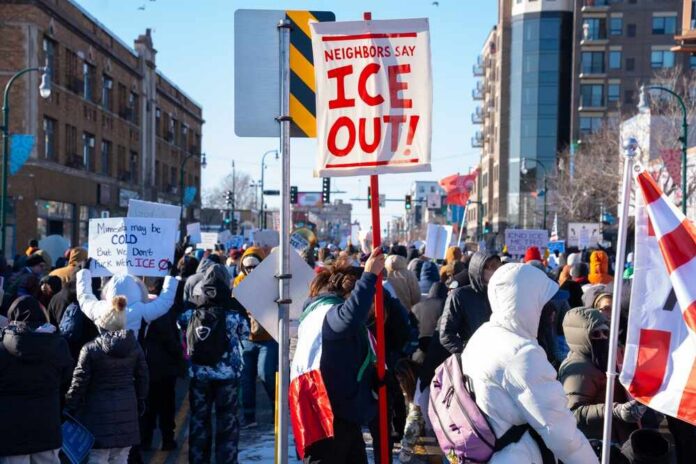
The available reporting points to a familiar American pattern: a volatile protest environment, competing narratives about responsibility, and a political temptation to read every clash through the lens of total ideological war. One report describes Minneapolis tension flaring during anti-ICE demonstrations after the fatal shooting of Renee Good, while another records a small anti-Islam protest met by a much larger crowd of counterprotesters downtown. That is enough to show agitation, crowd hostility, and a sharpened local conflict. It is not enough to show that Islam, Marxism, or some fusion of the two was the organizing principle of the unrest.
That distinction matters. Protest scenes often attract opportunists, counters, and symbolic combatants who want to convert a specific incident into proof of a larger thesis. The research package itself shows the gap between description and conclusion: the documented facts are about anti-ICE protests, counterprotests, and community tension; the ideological overlay is supplied by commentators and partisan framing. In rigorous terms, that is an inference, not an established finding.
The Muslim Brotherhood Is a Specific Organization, Not a Shortcut for Islam
The strongest source used to support the “Muslims, Marxists, and mayhem” framing is congressional testimony on the Muslim Brotherhood. That record is real and politically consequential: the hearing characterizes the Brotherhood as a militant Islamist organization with affiliates in many countries and depicts it as a gateway to jihadism. But that testimony does something narrower than the headline claim suggests. It targets an organization and a political-religious current; it does not demonstrate that Islam as a whole functions as an existential threat to the United States.
This distinction is not semantic hair-splitting. In security analysis, collapsing an organization into an entire faith tradition obscures the difference between an institution with leadership, affiliates, and tactics, and a religion practiced in many forms by millions of people. The research package gives no court record, intelligence assessment, or government study showing that Minnesota unrest was directed by Brotherhood-linked actors. Without that connective tissue, the claim remains a rhetorical leap.
Why the Marxism Angle Is Even Weaker Than the Islam Angle
The Marxism component is thinner still. Fox News reports on socialist and communist groups protesting in cities after a fatal ICE shooting, including chants aimed at officials. That is evidence that explicitly left-wing activists can show up in protest ecosystems and add combustible rhetoric. It is not evidence that “Marxism” is the causal architecture of the Minnesota unrest, much less that it is operating as a coordinated force with religious militants. In American street politics, small ideological contingents often attach themselves to broader grievances; that is a recurring feature of protest coalitions, not proof of hidden command-and-control.
The counter-evidence is also substantive on the theoretical level. Marxist Left Review states plainly that Marxists oppose bans on religion and defend freedom of religious belief and worship. Whatever one thinks of Marxism historically, that position undercuts the claim that Marxism inherently requires the destruction of religious communities. The more defensible reading is that some far-left activists may cooperate tactically with other dissident currents in particular protests, but that is a far cry from a durable “Islamo-Marxist” alliance with explanatory power over Minneapolis.
The Strongest Counter-Pattern: Muslims in Minnesota as Targets, Not Drivers, of Panic
If one wants to understand the social atmosphere around Minnesota, the more grounded evidence runs in the opposite direction. Sahan Journal reports that Muslim candidates in Minnesota, including Omar Fateh, have faced a consistent stream of threats. Rep. Ilhan Omar, in turn, accused Trump of inciting hatred of Islam. Those are not proof that every criticism of Muslim politics is invalid; they are proof that Muslim public figures in Minnesota occupy a highly exposed position in a climate where hostility toward Muslims is not theoretical. That changes the interpretive burden. A claim that Muslims are the primary source of unrest must overcome evidence that Muslims are also frequent targets of intimidation.
CBS News’ Minneapolis coverage of anti-Islam protesters being met by large counterprotester crowds reinforces the same point. Public reaction matters because it reveals where broad local sentiment sits. A fringe group can provoke a scene, but outnumbered protesters do not amount to evidence of majority support for their framing, and the mere existence of counterprotest does not prove ideological victory either. It does, however, show that the anti-Islam narrative is contested on the ground, not simply awaiting confirmation.
How These “Red-Green” Narratives Usually Work
The broader context supplied in the research package is essential. The “Islam-Marxism threat” storyline belongs to a longer tradition of red-green rhetoric, in which politically opposed movements are portrayed as tactical partners against Western civilization. That framework has survived because it is narratively elegant: it lets one explanation absorb several anxieties at once—immigration, urban disorder, elite betrayal, and demographic change. But elegance is not evidence. The same package notes that this style of argument has recurred for decades and thrives in media environments that reward conflict over verification.
That historical pattern helps explain why the Minnesota story keeps being stretched past its factual core. A protest becomes an insurgency; a religious minority becomes an ideological bloc; a militant organization becomes shorthand for a civilization. Those moves are emotionally potent because they compress complexity into a single dramatic enemy. They are analytically weak because they erase the local, contingent, and often mundane causes that actually drive unrest: policing disputes, immigration enforcement, neighborhood grievance, activist mobilization, and reciprocal fear.
What a Serious Reader Should Conclude
The evidence supports a more restrained judgment than the framing suggests. Minnesota did experience tension, protest, counterprotest, and political hardening around immigration and Islam. It also hosted real anti-Islam mobilization and real left-wing protest activity. But the package does not substantiate the larger claim that Islam and Marxism together form an operational existential threat responsible for the unrest. The strongest documented facts point instead to a noisy, polarized civic environment in which multiple factions project their fears onto the same streets.
That is the durable lesson. When a story is presented as proof of civilizational collapse, the first question is not whether some alarming actors exist; they do. The first question is whether the evidence actually links those actors to the event being described. Here, it does not. What is proven is local disorder and ideological opportunism. What is not proven is the sweeping thesis built on top of it.
Sources:
zerohedge.com, timesofindia.indiatimes.com, enewspaper.latimes.com, nytimes.com, congress.gov, foxnews.com