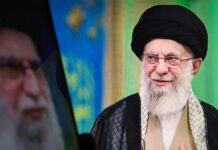

The vast, multi-day funeral procession for Ali Khamenei is not just a farewell to a long‑time ruler; it is a carefully engineered display of mass emotion and power that shows how the Islamic Republic turns martyrdom into political capital at moments of extreme vulnerability.
Key Points
- Khamenei’s funeral is a six‑day, multi‑city state ritual designed to project regime resilience and religious legitimacy, from Tehran and Qom to Najaf, Karbala, and Mashhad.
- Millions of mourners have been mobilized under tight security, blending Shi’a mourning practices with explicit calls for vengeance against the United States, Israel, and Donald Trump.
- The official narrative frames Khamenei as a “martyred Leader” killed in joint US‑Israeli airstrikes, yet independent, forensic corroboration of the strike and cause of death remains notably absent.
- The regime’s mastery of martyrdom narratives—rooted in decades of revolutionary and wartime practice—explains both the scale of the funeral and its role in shaping Iran’s domestic and regional posture.
The Architecture of a Multi‑City State Funeral
The funeral for Ali Khamenei has been structured as a prolonged national rite, stretching from July 4 to July 9 and moving across a symbolic geography of the Islamic Republic. The itinerary announced by official bodies is precise: a two‑day lying in state at Tehran’s Grand Imam Khomeini Mosalla on July 4–5; a major procession through the capital on July 6; ceremonies in the seminary city of Qom on July 7; transfer of the casket to Iraq for commemorative events in Najaf and Karbala on July 8; and final burial in Mashhad on July 9 at the shrine of Imam Reza, the eighth Shia imam. This choreography is not incidental. It ties Khamenei’s memory to the foundational nodes of Iran’s revolutionary story—Tehran and Qom—and to the transnational Shi’a landscape in Iraq before closing in the spiritual gravity of Mashhad.
Organizers have openly planned for extraordinary crowds, with Iranian state outlets forecasting tens of millions of participants over the course of the week, and foreign reporting such as the Financial Times estimating 12–15 million people in Tehran alone on July 6. The funeral schedule, first announced more than 100 days after his death in late February, reflects both logistical concerns and the desire to align key rites with religious dates, including the eve of Imam Sajjad’s martyrdom. Stretching the ceremonies across cities, days, and liturgical markers serves a clear purpose: it transforms a single death into a national and regional cycle of mourning, remembrance, and mobilization.
Tehran’s Procession: Mass Grief, Choreographed Rage
The core of the funeral spectacle unfolded in Tehran. On July 6, caskets believed to contain Khamenei and four family members, draped in the Iranian flag, were placed on a decorated semi‑trailer and moved slowly through the city’s main arteries. State television and international feeds show dense crowds—many dressed in black, beating their chests in the traditional latmiyat rhythm of Shi’a mourning, and stretching out to touch the glass enclosure that protected the coffins. The procession reportedly lasted around 12 hours and culminated at Mehrabad International Airport, from which the body would later travel onward.
This was not a quiet funeral. Mourners chanted “Death to America” and slogans calling for the killing of Donald Trump, while waving red flags symbolizing revenge. American and British flags were burned; banners showed crosshairs superimposed on Trump and Israeli Prime Minister Benjamin Netanyahu. In on‑the‑ground coverage, one mourner addressed Trump directly: “I will take revenge on you for the blood of our leader. Be sure of it.” These are not spontaneous outbursts in an otherwise apolitical ritual. They are integral to the event’s framing, merging religious lament with explicit calls for retaliation against named foreign adversaries.
Security forces—the Islamic Revolutionary Guard Corps (IRGC) and the Basij paramilitaries—maintained tight control along the route. Barriers, checkpoints, and controlled camera vantage points ensured that the images disseminated to the world were of orderly, fervent masses rather than chaotic or contested gatherings. Drone footage and satellite images used by outlets sympathetic to Tehran emphasize the sheer scale of the crowd, reinforcing the message that the regime still “owns the streets” despite years of internal unrest.
Numbers, Absences, and What We Can’t Yet Verify
The Iranian state’s claim that 15 million people attended the Tehran procession sits at the heart of the narrative of overwhelming support. Crowd figures in such contexts are notoriously difficult to verify, and in this case independent, methodologically robust counts—using aerial imagery and density analysis—have not been publicly released. The Financial Times’ 12–15 million range hints that at least some external observers find very large numbers plausible, but we lack transparent, third‑party data to confirm the upper bound. What can be said with confidence from visual evidence and multiple outlets is that the turnout in Tehran ranks among the largest funeral gatherings in modern history.
More consequential than the headcount is who was missing. Iran’s new Supreme Leader, widely reported to be Khamenei’s son Mojtaba, did not appear at the Tehran procession or the subsequent Qom ceremonies, and no video or audio message from him has surfaced. Rumors suggest he was severely injured or disfigured in the same late‑February strikes that killed his father, possibly in hiding for security and political reasons, but these reports remain unconfirmed by any official communiqué. Instead, a senior theologian led prayers, and other establishment figures—Khamenei’s brothers, the IRGC commander, prominent clerics from Qom and Iraqi shrine cities—occupied the front of the ritual stage. In a system that has spent decades personalizing authority in one man, such an absence at the defining funeral ceremony is striking and underscores the uncertainty of succession, even as the regime projects stability.
The most contested fact is the cause of Khamenei’s death. Iranian state media, and many regional outlets that echo its line, assert that he was killed at age 86 in joint US‑Israeli airstrikes on his compound in Tehran on February 28, which marked the opening hours of the latest Iran–US/Israel conflict. The head of Iran’s Legal Medicine Organization has publicly claimed thousands of fatalities—3,375—in those strikes. Tehran’s narrative is consistent, dramatic, and framed in explicitly martyrdom‑laden language: state TV described him as having “drunk the sweet, pure draft of martyrdom” and joined the “Supreme Heavenly Kingdom.”
Yet independent forensic corroboration is thin. There is no accessible official Iranian autopsy or medical certificate specifying airstrikes as the cause of death. Western governments have not released declassified satellite imagery, strike footage, or debris analysis verifying a successful attack on Khamenei’s residence. Reuters has cited anonymous Israeli officials claiming Khamenei’s remains were found, but without detail on identification methods or chain of custody. In short, the martyrdom narrative is asserted
Martyrdom Narratives as a Tool of Power
To understand why the regime pushes the airstrike martyrdom story so hard, one has to situate this funeral within a longer history of how the Islamic Republic works with death. Since the 1980–88 Iran‑Iraq War, the state has relied on martyrdom narratives—stories of holy sacrifice in the face of foreign aggression—to bind disparate constituencies into a moral community and justify both repression and retaliation. Scholars of Iranian political culture and conflict framing have documented how Tehran invests immense resources in rituals that turn victims of violence, often including those killed by its own forces, into martyrs of external tyranny.
This repertoire is deeply rooted in Shi’a theology. The paradigmatic martyr in Shiism is Imam Husayn, killed in the 7th‑century Battle of Karbala for refusing allegiance to a caliph he deemed illegitimate. Annual Ashura rituals—chest‑beating, processions, elegies—retell his death in ways that collapse time, drawing a direct line from ancient injustice to contemporary struggles. Khamenei’s funeral borrows these forms and symbols; the red flag of revenge raised over Jamkaran Mosque in Qom, for instance, is a directly coded signal that the community’s honor demands retaliation for his killing.
Modern political science work on Iran emphasizes that these emotional frames are not improvisations but part of a dense organizational infrastructure: tens of thousands of mosque centers, millions of Basij members, university and workplace networks, and specialized propaganda institutions sustain pro‑government mobilization throughout the year. When a major figure dies—especially under circumstances the state attributes to foreign enemies—that machinery can rapidly fill streets and squares with orchestrated mourning, as has happened in Tehran, Mashhad, Qom, and provincial cities since his death was confirmed.
Martyrdom is particularly useful for a regime under sanctions and domestic pressure. As one analysis puts it, “sanctions reinforce narratives of persecution; martyrdom absorbs punishment and converts it into meaning.” Framing Khamenei as a victim of US‑Israeli aggression allows Tehran to recast years of economic hardship and military confrontation as part of a sacred struggle, rather than policy failure. It also provides a moral rationale for retaliatory action, whether through direct strikes on US and Israeli assets or via allied militias such as Hezbollah, which has already invoked Khamenei’s death in its own rhetoric.
Where the Narrative Meets Geopolitics
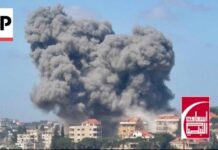
This funeral is taking place against an active conflict background. Reports detail tit‑for‑tat strikes between Israel and Hezbollah, threats from Netanyahu’s government to apply a “Gaza model” of massive destruction in Lebanon, and complex negotiations involving the United States and Iran, sometimes excluding Israel. Within that context, Khamenei’s death—and, crucially, the way it is framed—becomes a bargaining chip and a rallying cry. Iranian allies in Iraq staged symbolic funeral processions in Najaf, carrying coffins and portraits to signal solidarity and shared grievance.
At home, the funeral processions shore up the regime’s authority in the face of succession uncertainty and strained legitimacy. Analyses of recent protest cycles in Iran, including the “Woman, Life, Freedom” movement, show that state media has increasingly relied on pro‑regime victim narratives to evoke moral judgement and emotional responses, transforming its own casualties into tools of repression. In that sense, Khamenei’s funeral is both exceptional—a farewell to a supreme leader killed in war—and continuous with a pattern: a narrative war over the dead, fought in streets, on television, and across social platforms.
Internationally, the lack of clear forensic evidence and the refusal of US and Israeli officials to confirm or deny operational details create an ambiguous space in which competing audiences interpret the same event differently. For regime loyalists and much of the Shi’a world, Khamenei died a martyr in an unjust foreign strike. For skeptical Western observers, he is the subject of a powerful but unverified story, one that must be understood politically rather than literally until more data emerge. The funeral’s images—endless waves of mourners, flags of revenge, chants against Trump—will continue to circulate far beyond Iran’s borders, shaping how this conflict is remembered regardless of the eventual historiographical verdict on what happened on February 28.
The funeral procession for the martyred Leader of the Islamic Revolution Ayatollah Seyyed Ali Khamenei moved to Qom on Tuesday, with tens of thousands of people in attendance.https://t.co/MzH3pMxRT5
— Mehr News Agency (@MehrnewsCom) July 7, 2026
What This Funeral Reveals About the Islamic Republic’s Future
Beyond its immediate drama, the fourth and subsequent days of Khamenei’s funeral procession illuminate three enduring features of the Islamic Republic. First, the regime retains formidable street‑mobilization capacity. Predictions that war, sanctions, and protests had exhausted its ability to stage mass events have not borne out; the apparatus of mosques, Basij, and propaganda still delivers millions into public space when the state demands it.
Second, martyrdom remains central to how the regime narrates itself to its citizens. Even as segments of the population grow more secular or cynical, the emotional power of martyr narratives endures, especially when tied to foreign attack and national dignity. Analysts caution that such narratives “only work when the population views the figure as holy,” and that eroded legitimacy can blunt their effect. Khamenei, for his supporters, still occupied that holy space; the funeral suggests that, at least within the pro‑regime camp, his sanctified image is intact.
Third, succession and accountability are unresolved. The new leader’s absence, the opacity surrounding the February strikes, and the lack of transparent institutional communication point to a system that still depends heavily on secrecy and narrative control. That may be sustainable in the short term, particularly during wartime; over the longer arc, it raises questions about how stable a political order is when its most consequential events cannot be independently verified.
For now, what can be seen is the funeral itself: a river of mourners, a moving platform bearing flag‑draped coffins, the roar of chants demanding vengeance, and the quiet but unmistakable presence of security forces shaping every frame. It is a portrait of a regime confronting mortality—its leader’s and perhaps its own—and answering, as it has for decades, with the language of martyrdom, mass ritual, and managed rage.
Sources:
youtube.com, euronews.com, newsfeed.wtjx.org, cnn.com, reutersconnect.com, facebook.com, arabnews.com, journalofdemocracy.org, sundaytimes.lk, spectator.com.au, lup.lub.lu.se, lithub.com