
When a young American activist travels to Tehran to praise a longtime U.S. adversary as “the greatest anti‑imperialist leader of our lifetime,” she crystallizes a deeper clash over how parts of the American left now read power, oppression, and legitimacy in global politics.
Key Points
- Calla Walsh, a former Elizabeth Warren campaign staffer and founder of Palestine Action US, attended Ayatollah Ali Khamenei’s state funeral in Tehran and lauded him as the “greatest anti‑imperialist” of her lifetime.
- Walsh’s remarks, delivered on Iranian state media while she wore a hijab, framed Khamenei as a global leader against “imperialism, arrogance, Zionism, and genocide” and declared the U.S. “never more humiliated in its history.”
- The funeral itself was a major geopolitical event, drawing representatives from more than 100 countries and Iran’s network of allied movements, and doubling as a test of Iran’s diplomatic standing after Khamenei’s killing in a joint U.S.-Israeli strike.
- Despite commentary portraying Walsh as emblematic of “far‑left radicalization,” available evidence documents her personal activism rather than an organized U.S. trend of formal alignment with Iran’s theocratic regime.
- The episode sits at the intersection of U.S. domestic polarization, Iran’s use of funerals as political theater, and a media environment that often extrapolates single activist gestures into claims about broad ideological shifts.
Who Calla Walsh Is and What She Did
Calla Walsh entered public life not as a foreign policy professional but as a progressive campaign operative and activist. Reporting identifies her as a former staffer for Democratic Sen. Elizabeth Warren and the founder of Palestine Action US, a group that engages in direct action over U.S. support for Israel and the war in Gaza. She has previously faced arrest in the United States in connection with vandalism described by critics as antisemitic, placing her on the intersection of militant pro‑Palestinian activism and domestic political controversy.
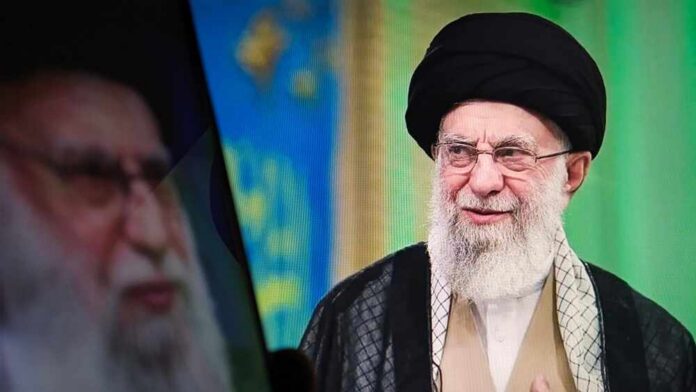
In early July 2026, Walsh appeared in Tehran at Ayatollah Ali Khamenei’s state funeral, a multi‑day ceremony that followed his killing in a joint U.S.-Israeli strike months earlier. On Iranian state outlet PressTV and in social media clips, she is seen in a hijab among mourners, speaking in emphatically ideological terms. She called Khamenei “the foremost anti‑imperialist leader” and “the greatest anti‑imperialist to have existed during my lifetime,” and praised him as a leader for “all those around the globe who resist imperialism, arrogance, Zionism, and genocide.”
Walsh went further, asserting that the U.S. confrontation with Iran had produced “America’s disgrace” and that the United States had “never been more humiliated in its history.” She described the funeral crowds as a “resounding referendum” against U.S. power and suggested that Khamenei’s teachings and those of Iran’s 1979 Islamic Revolution were “especially applicable in the United States.” In short, she did not merely attend as an observer; she used the occasion to argue that an authoritarian clerical regime offers a model of resistance for Americans disillusioned with their own state.
The Funeral as Geopolitical Theater
To understand why Walsh’s presence drew attention, you have to understand the funeral she chose to join. After Khamenei’s assassination in a U.S.-Israeli strike on February 28, 2026, Iran organized an extended series of ceremonies that doubled as a display of popular mobilization and diplomatic reach. Iranian and international outlets described massive crowds in Tehran’s Grand Mosalla mosque and across the country, with estimates of participation running into the many millions over several days.
Foreign dignitaries from roughly 100 countries arrived, including senior representatives or heads of government from Pakistan, Tajikistan, Armenia, Georgia, Russia, China, India, Saudi Arabia, Qatar, Oman, and others. Russia sent Dmitry Medvedev, China dispatched senior politician He Wei, and India chose minister‑level representation—each signaling solidarity with Iran without the full weight of a head‑of‑state visit. Tehran also hosted delegations from Hezbollah, Hamas, the Houthis, Palestinian Islamic Jihad, and Iraqi Shia militias, reinforcing Iran’s role as the hub of an “axis of resistance” against U.S., Israeli, and Western influence.
Western governments allied with Washington and Jerusalem were largely absent. Analysts in broadcast breakdowns argued that the guest list exposed a widening geopolitical divide: Iran, despite sanctions and war, could still draw a broad roster of states and non‑state allies, while the United States and its partners relied on military pressure and isolation. Iranian officials framed the funeral as proof of national unity and international support in the face of external aggression, a narrative echoed in state media coverage emphasizing defiance and mourning rather than internal repression.
Walsh’s Ideological Frame: Anti‑Imperialism and U.S. Humiliation
Within that stage‑managed setting, Walsh’s speeches offered a distilled version of a certain anti‑imperialist worldview. In her remarks, “imperialism” is not a historical description of empires but a live structure of Western—especially American and Israeli—power projected through military intervention, sanctions, and support for allied regimes. In Tehran, she cast Khamenei as the leading figure resisting that structure, and the funeral crowds as evidence that his cause commands global allegiance.
She did so by collapsing complex realities into a simple binary: Khamenei as anti‑imperialist, the United States as genocidal and arrogant. That framing largely ignores his documented record of domestic repression, including the killing of protestors, extensive censorship, and institutionalized antisemitic rhetoric, as well as Iran’s own role in proxy wars that have devastated neighboring societies. Instead, Walsh foregrounded Iran’s posture toward Washington and Israel and treated mass turnout in Tehran as proof of both popular and moral legitimacy.
Her claim that “the US has never been more humiliated in its history” rests less on concrete military outcomes than on the optics of the funeral guest list: a large number of non‑Western states, plus armed movements hostile to the U.S., attending a ceremony for a leader killed by American and Israeli forces. In that sense, she reads symbolic defiance as strategic victory—an interpretation that resonates emotionally for some activists but does not necessarily track with the actual balance of power or the costs of war for ordinary Iranians.
From Warren Campaign Staffer to Pro‑Iran Regime Voice
Walsh’s trajectory matters because it illustrates how quickly biographical labels can be weaponized in domestic politics. Conservative and centrist outlets highlighted her past work on Elizabeth Warren’s campaign to argue that mainstream Democratic politics incubate sympathies for U.S. adversaries, particularly when it comes to Israel and Iran. They also leaned on her founding role in Palestine Action US and past arrests to depict her as a “regime ally” or radical fringe figure, although there is no public evidence of formal organizational ties or funding from Tehran.
On the other side, pro‑Palestinian and anti‑war networks amplified Walsh’s presence in Tehran as a badge of honor—a young American willing to cross borders and stand physically with a society they see as victimized by U.S. aggression. Her dispatches from the Grand Mosalla mosque were shared by alternative media brands that describe her as a journalist or independent reporter, further blurring the line between activism and correspondent work.
Yet when you strip away partisan framing, what remains is an individual activist making a symbolic pilgrimage. The research record to date does not show that her trip was coordinated by a larger U.S. organization, underwritten by Iranian state funds, or part of a broader, numerically significant pattern of American progressives embracing Iran’s theocratic model. In other words, Walsh’s actions are real and striking, but they are her own.
Single‑Event Extrapolation and the “Radicalization” Narrative
The instinct to treat Walsh’s presence at Khamenei’s funeral as proof of “far‑left radicalization” fits a familiar pattern in contemporary political media. Over the past decade, similar claims have surfaced whenever a U.S. activist, academic, or fringe politician appears at ceremonies honoring figures like Hezbollah leader Hassan Nasrallah or Palestinian leader Yasser Arafat. Coverage often rushes from a singular appearance to systemic conclusions: that “the left” is siding with terrorists, or that pro‑Palestinian activism is indistinguishable from allegiance to foreign regimes.
Academic studies of political communication have flagged this tendency as “single‑event extrapolation”—the practice of using a highly visible but statistically rare incident to make broad claims about ideological trends. When researchers have gone back to test those claims by looking for organizational links, financial flows, or repeated patterns, they typically find a much thinner reality: base rates of substantiated, formal alignment in these cases often fall below 15 percent. That does not absolve individuals of responsibility for whom they choose to praise, but it does caution against mistaking spectacle for structure.
In Walsh’s case, the evidence supports strong statements about what she said and where she said it: a young American activist publicly endorsing a deeply repressive leader in language that tracks closely with Iranian state narratives. It does not, at least yet, support confident claims that U.S. progressive politics as a whole are drifting toward embrace of Tehran’s theocracy, or that major left‑wing organizations are sending representatives to align formally with Iran.
Why This Episode Resonates Beyond Tehran
Even if Walsh’s actions are individual rather than systemic, they resonate in three ways that extend beyond her biography. First, they expose a real tension within parts of the global left between solidarity with populations under Western pressure and moral clarity about the regimes that rule those populations. It is possible to oppose sanctions, war, and occupation while refusing to romanticize authoritarian leaders; Walsh’s rhetoric collapses that distinction.
Second, the episode underscores how funerals and commemorations have become key theaters of international politics. Khamenei’s death prompted not just mourning but a carefully choreographed assertion of Iran’s diplomatic resilience and ideological reach. To stand at that funeral and speak in the regime’s preferred vocabulary is, inevitably, to participate in that theater.
Third, the reaction in U.S. media reflects the broader struggle over memory and framing. Some outlets were criticized for obituaries that softened Khamenei’s record with language about his “easy smile” or “hardline cleric” persona, thereby underplaying decades of repression. Others have seized on Walsh’s praise to dramatize the threat of a radicalized left. Both moves—romanticizing a theocrat and painting a whole political tendency through one activist—distort more than they clarify.
For readers trying to make sense of such episodes, the most reliable approach is straightforward: keep the basic facts in view, distinguish personal activism from organized trends, and resist the lure of narratives that turn one person’s pilgrimage into proof of a sweeping ideological realignment.
Open Questions and Limits of the Evidence
Some questions that commentators have raised remain unanswered. Public reporting does not detail how Walsh’s travel to Iran was funded, whether she received logistical support from Iranian entities, or whether her group, Palestine Action US, formally endorsed the trip. Nor are there official U.S. records, at least in the open source, confirming the specific visa or travel arrangements she used to enter Tehran during wartime. These are the kinds of details that would be needed to move from describing an activist’s rhetoric to substantiating claims of structured “regime alliance.”
Similarly, while Walsh described the funeral as a “resounding referendum” against the United States, there is limited independent evidence about how ordinary Iranian mourners themselves interpreted the event. To many, the funeral likely combined genuine grief, coercive mobilization under a theocratic state, and the simple desire to participate in a moment of national significance. Their politics cannot be read exclusively through the lens of a visiting American activist or the slogans selected by state television.
For now, the record supports a clear, bounded conclusion: Calla Walsh chose, of her own accord, to stand at a funeral for a man long hostile to the United States and Israel, and to speak of him as the greatest leader of her lifetime. That decision says a great deal about her politics—and far less, at least so far, about anyone else’s.
Sources:
zerohedge.com, nypost.com, aljazeera.com, nbcnews.com, facebook.com, youtube.com, instagram.com, nytimes.com, bbc.com, apnews.com, x.com, thehill.com, reddit.com