
The central reality of the Ukraine war’s “food front” is no longer in dispute: Russia has systematically targeted and constrained Ukraine’s grain export routes, turning one of the world’s breadbaskets into a lever over global food prices and food security.
Key Points
- Russia’s blockade of Ukraine’s Black Sea ports and withdrawal from the Black Sea Grain Initiative sharply curtailed Ukraine’s ability to export grain by sea, forcing costly and limited overland alternatives.
- Following its exit from the UN‑brokered deal in July 2023, Russia escalated strikes on Ukrainian ports, silos, and grain terminals and issued threats against ships bound for Ukrainian ports, chilling commercial shipping.
- Ukraine and many partners argue that Moscow is “weaponizing” food: using export disruption to damage Ukraine’s economy, gain sanctions leverage, and pressure countries dependent on Black Sea grain.
- The resulting supply shock and risk premia have contributed to reduced Ukrainian exports, higher global wheat and corn prices, and increased food insecurity, especially in import‑dependent regions.
From breadbasket to battleground: how Ukraine’s grain exports became a strategic target
Before the full‑scale invasion, Ukraine was deeply embedded in global food markets. It was a top exporter of wheat, corn, barley, sunflower oil, and other bulk commodities, with output large enough to feed hundreds of millions of people worldwide. Those exports moved primarily by sea through Black Sea ports such as Odesa, Chornomorsk, and Pivdennyi. When Russia launched its invasion in February 2022, it did not only send tanks across borders; it also deployed its navy to seal off Ukraine’s coastline.
Analysts and legal scholars describe what followed as a de facto naval blockade: Russian warships and naval mines effectively trapped an estimated 20–25 million tons of grain in Ukrainian ports, making normal commercial shipping impossible. In the first ten months of the war, model‑based estimates suggest Ukraine’s top agricultural exports fell by roughly half compared with prewar levels. This was not a marginal adjustment; it was a shock to one of the world’s core food supply arteries.
The Black Sea Grain Initiative: a temporary safety valve
Mounting concern over global food prices, especially in vulnerable import‑dependent countries, pushed the United Nations and Turkey to broker the Black Sea Grain Initiative (BSGI) in July 2022. The deal created a monitored maritime corridor for Ukrainian grain and other foodstuffs to move from three Black Sea ports under specific security guarantees. For a year, this arrangement partially restored flows: exports through the corridor climbed back toward prewar volumes, easing pressure on wheat and corn markets.
Even during the deal’s life, however, Ukraine accused Russia of “salami slicing” the corridor’s effectiveness. Kyiv and its partners documented repeated instances where Russian representatives in the Joint Coordination Centre in Istanbul slowed inspections to a crawl—sometimes to one or two vessels per day—and blocked the use of particular ports, creating long queues and under‑utilization of port capacity. President Volodymyr Zelenskyy argued that deliberate inspection delays and artificial queues had cost Ukraine roughly three million tons of exports over the initiative’s operation—enough grain, he noted, to feed about 10 million people for a year.
Russia walks away and opens a new phase of the “food war”
On July 17, 2023, Russia terminated its participation in the BSGI, despite UN and Turkish efforts to keep it alive. Moscow justified the move by claiming Western sanctions were obstructing Russian food and fertilizer exports, arguing there was “no ground” for continuation until its own exports were “normalized.” Within days, the character of the conflict at sea changed.
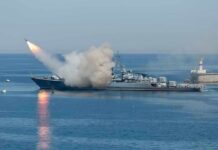
First, Russia made its blockade more explicit. Its defense ministry announced that all vessels bound for Ukrainian ports in the Black Sea could be treated as potential carriers of military cargo, and that the flag states of such ships could be considered parties to the conflict. Insurers and shipping companies took those warnings seriously; several major operators suspended calls to Ukrainian ports, and wheat prices on global exchanges jumped on the renewed war‑risk premium.
Second, Russia intensified direct strikes on Ukraine’s export infrastructure. Reporting from the UN, the EU, and independent analysts documents repeated missile and drone attacks on port facilities at Odesa and along the Danube, as well as on grain storage, loading terminals, and rail nodes linking farms to ports. By late 2024, Ukraine’s foreign minister tallied roughly 50 attacks against Black Sea ports alone, damaging more than 300 pieces of port infrastructure and 23 civilian vessels, and destroying over 100,000 metric tons of agricultural products.
“Weaponizing food”: intent and strategy
Ukraine’s government has argued consistently that these actions amount to using food as a weapon—what Foreign Minister Dmytro Kuleba has called “food terrorism” and “blackmail of the world.” In formal statements, Kyiv accuses Russia of a deliberate two‑track strategy: first, to cripple Ukraine’s agricultural export machine in order to cut off one of its largest sources of foreign exchange and tax revenue; second, to leverage the resulting global supply shortfall to extract sanctions relief and political concessions from countries anxious about food prices.
European institutions and many Western governments broadly share that assessment. The European External Action Service and independent think tanks describe a pattern in which Russian forces systematically target farms, silos, grain elevators, and transport infrastructure, while blockading ports and seeding sea lanes with mines, with the result of “hindering nearly all of Ukraine’s exports, notably of grain.” A 2025 report by Global Rights Compliance—a legal NGO specializing in atrocity crimes—goes further, arguing that the evidence points to an orchestrated campaign to dismantle Ukraine’s agricultural economy and grain export corridors as such.
From Moscow’s perspective, the narrative is different. Russian officials insist they are not weaponizing food but responding to Western sanctions and alleged Ukrainian misuse of commercial shipping for military purposes. They frame the Black Sea measures as legitimate economic warfare and security policy—tools that, while harsh, are portrayed as symmetrical to Western financial and energy sanctions. That framing does not change the material effect on ports, ships, and cargo; it does illustrate how modern conflict merges sanctions, blockades, and infrastructure strikes into a single pressure system.
Economic warfare and global food security
Regardless of declared motives, the impact on global food systems has been significant. Studies of trade and price data over the first years of the war consistently find large drops in Ukrainian exports of wheat and maize—often on the order of 70–90 percent at early stages—and persistent underperformance relative to prewar baselines. A 2025 CSIS assessment estimates that exports of Ukraine’s main grains were still about one‑third lower than in 2020, the last pre‑invasion harvest year.
The immediate channel is physical disruption and higher transport costs. With Black Sea routes heavily constrained, Ukraine has been forced to re‑route shipments via Danube ports, rail through EU neighbors, and, later, through a more risky alternative Black Sea corridor hugging the coasts of Romania and Bulgaria. These paths are slower, narrower, and more expensive than direct deep‑water exports. That means fewer tons reach global markets, and those that do carry a war‑risk and logistics premium that feeds into international prices.
The global consequences are uneven but real. Countries in North Africa, the Middle East, and parts of sub‑Saharan Africa that rely heavily on Black Sea wheat and sunflower oil have borne the brunt of higher import bills and volatility. International organizations warned early on that Russia’s blockade could push tens of millions of people toward acute hunger if not offset by alternative supplies and assistance. While bumper crops in other exporting regions and demand adjustments have prevented outright catastrophe, the war has clearly aggravated an already fragile global food security landscape stressed by climate shocks and pandemic aftershocks.
Ukraine strikes back: Russian exports under pressure too
The conflict over food flows is not one‑sided. As the war has dragged on, Ukraine has increasingly targeted Russian economic infrastructure with long‑range drones, including energy assets and, more recently, nodes in Russia’s own food and fertilizer export chains. Strikes on refineries, oil terminals, and shipping in the Sea of Azov have disrupted traffic along routes that carry a significant share of Russia’s wheat exports—by some estimates, up to a quarter.
These attacks have helped trigger a domestic fuel crunch inside Russia, forcing Moscow to ban or limit diesel exports at various points to secure supplies for its own agriculture and transport sectors. Analysts describe a knock‑on effect in which higher diesel costs and shortages delay Russian harvests, raise transport and drying costs, and squeeze smaller farms hardest. That dynamic does not erase Russia’s much larger export base, but it shows how economic warfare in one direction invites symmetric pressure in the other.
There is an important asymmetry, however: Russia, as the world’s largest wheat exporter and a major fertilizer supplier, has more capacity to re‑route its exports via alternative ports and logistics under its control. Ukraine, by contrast, lives or dies by access to a handful of ports under constant threat. The result is that Ukraine’s agriculture sector bears a disproportionate share of the conflict’s damage, while many importing countries face simultaneous vulnerability to disruptions of both Ukrainian and Russian supplies.
Law, norms, and the blurred line between military and civilian targets
Legally, the use of blockade and port strikes as economic warfare is not new. Under the law of naval warfare, blockades that meet specific conditions of notification, effectiveness, and discrimination can be considered lawful, even when they have foreseeable economic and humanitarian consequences. However, modern international humanitarian law also prohibits starvation of civilians as a method of warfare and protects objects indispensable to civilian survival.
Where Russia’s conduct sits along that spectrum is now the focus of ongoing legal and policy debate. The pattern documented by Ukraine’s partners—repeated attacks on clearly civilian grain terminals and cargo ships; generalized threats against all vessels heading to Ukrainian ports; and deliberate obstruction of a humanitarian‑oriented export corridor—has led many governments and legal advocates to argue that the campaign crosses from traditional blockade into unlawful weaponization of food. A final legal judgment will take years, but the broader normative damage is already visible: if left unchallenged, this playbook establishes a precedent that other states may be tempted to copy in future conflicts.
What this means for the next phase of the war and for global food policy
Strategically, Russia’s pressure on Ukraine’s food exports serves several purposes at once: it weakens a critical pillar of Ukraine’s economy, undermines Kyiv’s fiscal and political resilience, and creates leverage over third countries highly exposed to Black Sea supplies. For Ukraine and its partners, that makes securing alternative export routes—not just military aid—a central component of war strategy.
Looking ahead, three implications stand out. First, any durable ceasefire or settlement will have to address not only borders and security guarantees but also the status of sea lanes, port infrastructure, and agricultural exports. Leaving those questions vague is an invitation to renewed coercion. Second, global food security architectures—from World Food Programme procurement practices to regional grain reserve schemes—will need to adapt to a world where a single actor can, in effect, turn off a major export tap overnight. Diversifying suppliers and routes is no longer just an economic efficiency issue; it is a security requirement.
Third, the Ukraine case is now a textbook example of how energy, finance, and food can be weaponized together. Ukraine’s foreign minister recently captured the logic succinctly when he compared Russian strikes on Black Sea shipping to Iran’s threats to oil traffic in the Strait of Hormuz: one state going after energy routes, the other after food corridors. For policymakers and analysts, the lesson is stark: in modern great‑power conflict, shipping lanes full of grain can be as strategically important—and as vulnerable—as pipelines and undersea cables.
Sources:
19fortyfive.com, csis.org, reuters.com, theguardian.com, eeas.europa.eu, atlanticcouncil.org, fairobserver.com, mfa.gov.ua, bbc.com, press.un.org, pbs.org, europarl.europa.eu, rferl.org, cfr.org, consilium.europa.eu, youtube.com, pmc.ncbi.nlm.nih.gov, tandfonline.com, choicesmagazine.org, fao.org, globalrightscompliance.org, osw.waw.pl, lieber.westpoint.edu