

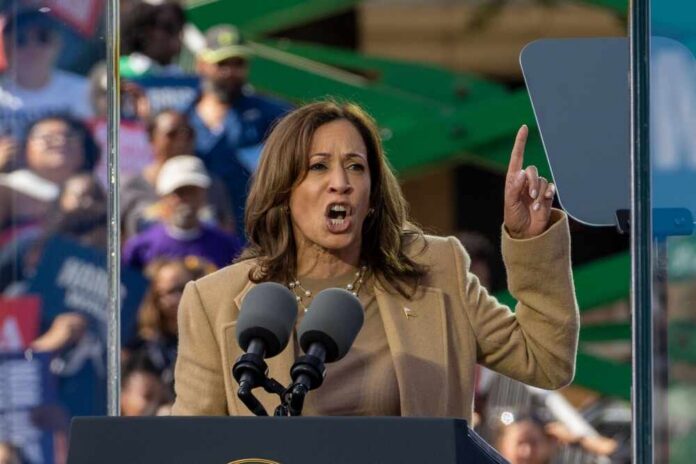
Virginia’s Supreme Court has invalidated a voter-approved congressional redistricting map, triggering fierce partisan warfare as former Vice President Kamala Harris accuses the ruling of helping President Trump “rig” the 2026 midterm elections while Republicans celebrate blocking what they call Democratic gerrymandering.
Story Snapshot
- Virginia Supreme Court struck down a congressional redistricting map approved by state voters in a ballot initiative
- Kamala Harris claims the ruling undermines democracy and assists Trump’s alleged efforts to manipulate the 2026 elections
- President Trump praised the decision as a “huge win,” calling the invalidated map a “horrible gerrymander” favoring Democrats
- The voter-backed map would have carried 6 of Virginia’s 11 congressional districts under previous configurations, potentially benefiting Democrats
- Uncertainty now surrounds which redistricting process will govern Virginia’s critical midterm elections
Court Overturns Voter-Approved Redistricting Initiative
The Virginia Supreme Court invalidated a congressional redistricting map that Virginia voters had approved through a ballot measure. The decision represents a significant judicial intervention into the state’s electoral process, nullifying what Democratic supporters characterized as a direct expression of democratic will. Analysis from the University of Virginia’s Center for Politics indicates the voter-approved map would have carried six of Virginia’s eleven congressional districts based on performance under the state’s previous map configuration. This outcome suggested a redistricting landscape potentially more favorable to Democratic candidates, amplifying the partisan stakes of the court’s intervention.
Harris Accuses Trump of Election Manipulation
Former Vice President Kamala Harris issued a sharp public rebuke of the Virginia Supreme Court ruling, characterizing it as antidemocratic and strategically beneficial to Republican electoral interests. Writing on X, Harris declared that the court “ignored the will of the people and overturned those democratically chosen maps.” She further claimed the ruling “gives a boost to Donald Trump’s effort to rig the 2026 elections and the Republicans’ long game to attack voting rights.” This inflammatory language reflects intensifying partisan polarization surrounding redistricting disputes. Harris’s use of terms like “rig” echoes broader Democratic messaging that frames Republican electoral strategies as fundamentally threatening to democratic representation and voting access.
Trump Celebrates Victory Against Democratic Gerrymandering
President Trump offered a starkly different interpretation of the Virginia Supreme Court decision, praising it as a “huge win” that prevented Democratic electoral manipulation. The Trump administration characterized the voter-approved map as a “horrible gerrymander” designed to unfairly advantage Democratic candidates in Virginia’s congressional races. This framing positions the court’s intervention not as judicial overreach but as a necessary correction to protect electoral fairness. Republicans argue that Democrats attempted to exploit the ballot initiative process to implement partisan redistricting while cloaking it in the language of democratic legitimacy. The clash illustrates how both parties accuse each other of gerrymandering while claiming to defend electoral integrity.
Midterm Electoral Consequences Remain Uncertain
The court’s invalidation of Virginia’s voter-approved redistricting map creates significant uncertainty for the 2026 midterm elections. Virginia’s eleven congressional seats represent a substantial electoral prize, and the final district boundaries will materially affect both parties’ prospects for controlling the House of Representatives. Sources do not clarify what alternative redistricting process will now govern Virginia’s congressional elections, leaving candidates, campaigns, and voters in limbo regarding district composition. Whether the Republican-controlled state legislature will implement an alternative map, the court will impose boundaries, or federal courts will intervene remains unresolved. This uncertainty complicates candidate recruitment, campaign planning, and voter engagement strategies as the midterm cycle intensifies.
Judicial Authority Versus Democratic Will
The Virginia redistricting dispute highlights fundamental tensions between judicial authority and direct democracy. Supporters of the invalidated map argue that courts should not overturn measures explicitly approved by voters through the ballot initiative process. This perspective emphasizes democratic legitimacy rooted in popular sovereignty. Conversely, defenders of the court’s decision maintain that judicial review serves as a necessary check against partisan manipulation, even when such manipulation is cloaked in democratic procedures. Both positions reflect legitimate constitutional principles, but their collision in Virginia underscores how redistricting has become a central battleground in broader conflicts over voting rights, electoral fairness, and governmental power. The outcome will establish precedent for future redistricting disputes nationwide.
Sources:
Harris accuses Trump of rigging 2026 elections after Virginia map ruling – The Kenya Times