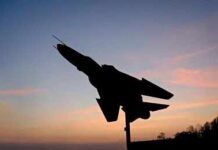


The F-35C stealth fighter nearly flies itself, revealing U.S. military might under strict legal limits that shield cutting-edge tech from prying eyes.
Story Highlights
- F-35C’s advanced autopilot and fly-by-wire systems enable near-autonomous flight, slashing pilot workload in combat.
- Rare media access showcases carrier-optimized stealth jet as game-changer for naval power projection.
- Combat-proven in Yemen strikes, with over 883 units operational by 2025 amid push for even greater autonomy.
- Lockheed eyes “pilot-optional” upgrades, bolstering America First deterrence against China and adversaries.
F-35C’s Revolutionary Automation
The F-35C carrier variant integrates fly-by-wire controls, sensor fusion, and AI-assisted stability to handle complex maneuvers with minimal pilot input. Radar, infrared, and electronic warfare data merge into a unified battlespace view, allowing the jet to maintain stability even in demanding conditions. This automation positions the F-35C as a flying command center, reducing cognitive overload for pilots facing anti-access threats. Carrier optimizations like folding wings and robust landing gear enable 1,200+ nautical mile range with 20,000 pounds of internal fuel. Supersonic speeds reach Mach 1.6 while carrying internal weapons, evading detection through very low observable stealth.
Proven in Combat and Carrier Ops
U.S. Navy pilots achieved initial operational capability in 2019, following first carrier landings in 2015 on USS George Washington. The F-35C debuted in combat during November 2024 Yemen strikes against Houthi targets, coordinating stealth precision with B-2 bombers. By 2025, over 883 units logged nearly one million flight hours across variants. These milestones validate the jet’s role in contested environments, where sensor fusion delivers unmatched situational awareness. Allies like Israel deploy customized F-35I versions for strikes on Iran-linked sites, demonstrating global interoperability.
Strategic Edge for National Security
Lockheed Martin, as prime contractor, drives the $2 trillion program to counter Pacific threats from China through A2/AD capabilities. The Navy prioritizes the F-35C’s long-range stealth for carrier strikes, internal payloads from 5,000 to 18,000 pounds enhance lethality. DoD and FAA enforce strict access rules, limiting demos to protect classified tech. Combat successes silence cost critics, affirming taxpayer investments in pilot safety and deterrence. This aligns with President Trump’s second-term focus on military strength amid GOP congressional control.
The F-35C Stealth Fighter ‘Flies Itself’: We Got As Close As the Law Allowshttps://t.co/JKe6lahie6
— Harry J. Kazianis (@GrecianFormula) April 20, 2026
Future Upgrades and Broader Impacts
Block 4 enhancements boost sensors and autonomy, nearing 1,000 deliveries. Lockheed CEO Jim Taiclet announced potential “pilot-optional” features via NGAD-derived tech, including advanced stealth coatings and AI software. These upgrades promise 80% next-gen capability at half the cost, pressuring adversaries to adapt defenses. Economically, the program sustains jobs and exports to 20+ nations, strengthening alliances. Politically, it reinforces U.S. superiority despite elite spending debates, echoing frustrations with government priorities over American security.
Sources:
Everything You Need to Know about the F-35C
Lockheed Martin F-35 Lightning II – Wikipedia