
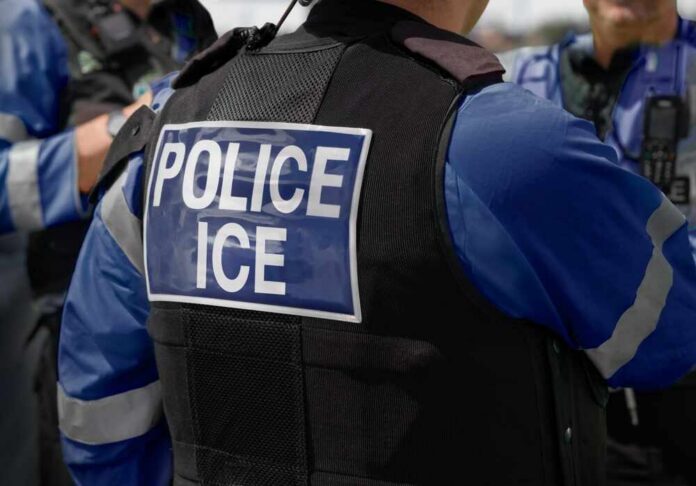
The fatal shooting of Joan Sebastián Durán Guerrero by an ICE agent in Biddeford, Maine is not an inexplicable one-off, but a textbook example of how high-risk vehicle stops in immigration enforcement can turn lethal—especially when officers are operating without cameras, under aggressive removal mandates, and with broad discretion to define “public safety” after the fact.
Key Points
- ICE agents shot and killed 26-year-old Joan Sebastián Durán Guerrero during a vehicle stop tied to a deportation warrant, even though he was not the person they were seeking.
- DHS says the vehicle “attempted to flee” and the agent fired “fearing for public safety,” but there is no body-camera footage and witnesses say Guerrero cried “I tried to stop” after the shots.
- The Maine attorney general and DHS agree the shooting occurred in the context of an immigration operation, yet the core justification for lethal force remains uncorroborated and contested.
- This is one of a series of ICE vehicle-stop shootings; within days, ICE suspended most traffic stops nationwide, signaling systemic concern about its own tactics.
- The case has triggered protests, political backlash, and renewed scrutiny of how ICE conducts surveillance, issues warrants, and uses deadly force against non-violent civilians.
What Happened in Biddeford: The Established Facts
Shortly after 7 a.m. in Biddeford, Maine, ICE Enforcement and Removal Operations agents were conducting targeted surveillance at the last known address of an individual with a final order of removal—a person DHS describes as an “illegal alien” subject to deportation. According to DHS’s public statement, a different “illegal alien” left that residence in a vehicle. ICE agents attempted a vehicle stop; DHS says the vehicle “attempted to flee the scene,” and an officer, “fearing for public safety,” discharged his weapon. The driver, later identified as 26‑year‑old Colombian national Joan Sebastián Durán Guerrero, was hit and died from his injuries at the scene or shortly thereafter.
The Maine attorney general’s office, which is responsible for reviewing police use of deadly force in the state, echoed part of DHS’s narrative: in its initial account, the office said Guerrero “attempted to flee in a vehicle in the direction of” an ICE officer before being fatally shot. Federal officials have emphasized that the shooting occurred during an attempt to serve or execute a deportation order, tying the incident directly to an immigration enforcement objective rather than a conventional criminal traffic stop.
A key clarifying fact emerged quickly: Guerrero was not the person ICE was there to arrest. Statements from DHS, Maine lawmakers, and members of Congress—including Senator Angus King’s office—confirm that he was not the warrant’s intended target. He had borrowed the vehicle to drive to work, and advocates and local reporting indicate he held authorization to work in the United States and a Social Security number.
DHS Narrative Versus Witness Accounts
The official justification for the shooting rests on a single phrase: “fearing for public safety.” DHS did not initially claim that the officer believed he was about to be personally killed or seriously injured; rather, the statement refers broadly to concern for public safety as the car allegedly attempted to flee. That nuance matters. In most high-profile police shootings involving vehicles, agencies assert that officers fired because they feared for their own lives—because the car was “weaponized” against them. Here, DHS chose different language, raising questions among legal analysts about whether the described threat meets standard deadly-force thresholds.
Without body-camera footage, the DHS account cannot be independently verified. ICE agents involved in the Biddeford shooting, like those in the Houston incident a few days earlier, were not wearing body cameras. That absence leaves investigators reliant on officer statements, physical forensics, and whatever surveillance video exists from neighborhood cameras. In this evidentiary vacuum, witness testimony assumes outsized importance.
Several neighbors have provided detailed accounts to local media and investigators. One witness told CBS 13 News he saw ICE vehicles box in Guerrero’s car at an intersection, heard gunshots, and then watched agents drag Guerrero from the vehicle as he bled from the head. According to this witness, Guerrero said, “I tried to stop,” before losing consciousness. The same witness later confronted an agent who claimed Guerrero “tried to run me over,” a justification that aligns more closely with a traditional “self-defense” narrative than DHS’s own “public safety” language.
CCTV footage reportedly shows multiple bullet holes in the car’s windshield, consistent with shots fired toward the front of the vehicle. Exactly how the car was moving—or whether it was moving at all—when those rounds were fired is a central factual question that remains unresolved publicly. Forensic analysis of trajectory, impact angles, and tire marks will likely determine whether the vehicle was accelerating toward an officer, trying to flee away, or already stopped when the shots were fired. That analysis has not yet been released.
An Innocent Target in a High-Risk Operation
Guerrero’s status in the United States complicates ICE’s operational justification. Immigrant rights advocates and multiple news outlets report that he was authorized to work in the country and held a valid work permit and Social Security number. DHS, however, described him as an “illegal alien” departing the residence of another targeted individual. Whether this reflects a paperwork gap, a misidentification, or a difference between work authorization and immigration status is not yet clear, but the mismatch has fueled public anger: a young father, doing what many residents do each morning—driving to work—was killed in an operation that did not name him.
The fact that Guerrero was not the subject of the deportation order is uncontested. Lawmakers in Maine and federal officials have repeated that point, and even DHS’s own language acknowledges that agents encountered “an illegal alien” leaving the address of another person under surveillance. That “wrong guy” reality shapes both legal scrutiny and public perception. Even if the agent’s split-second decision to fire were ultimately found lawful under use‑of‑force standards, the underlying operation clearly failed to distinguish between its intended target and an uninvolved neighbor borrowing a car.
How ICE Vehicle Stops Became a Systemic Problem
To understand why the Biddeford shooting drew such immediate national attention, you have to place it in the pattern of ICE vehicle-stop tactics over the previous year. Investigations by the Wall Street Journal and others have documented at least 13 incidents in which ICE officers fired at or into civilian vehicles since mid‑2025, resulting in two confirmed fatalities and multiple injuries. In Minneapolis, for example, an ICE officer shot and killed Renee Nicole Good during an operation; DHS initially asserted that she had “weaponized her vehicle” and tried to run over officers, a claim local officials challenged based on video evidence.
Congressional testimony and advocacy research point to broader growth in lethal encounters with ICE, both in the field and in detention. One congressional staff analysis notes that eight people had died in dealings with ICE by early 2026, including shootings and deaths in custody. Separate civil-rights reports trace how ICE’s expanding detention infrastructure and aggressive arrest goals have coincided with rising fatalities and serious injuries. These numbers do not prove that any given shooting was unjustified, but they do show that the use of deadly force is no longer rare in immigration enforcement.
Vehicle stops are a particularly fraught subset of that enforcement. A vehicle can be used as a weapon, but it is also a space where movement, commands, and perception are difficult to control. Traffic enforcement protocols in conventional policing typically emphasize containment, distance, and de‑escalation. In immigration operations, ICE officers often work without marked cars, without dash cams, and with administrative warrants that confer less judicial oversight than criminal warrants. That mix—covert surveillance, contested legal authority, no cameras, and the physical risk of cars—creates exactly the circumstances in which fatal misunderstandings can proliferate.
Policy Shock: ICE Suspends Most Vehicle Stops
The Biddeford shooting was the second fatal ICE vehicle-stop shooting in less than a week. Just days earlier in Houston, an ICE agent shot and killed Mexican national Lorenzo Salgado Araujo, claiming that Salgado rammed an ICE vehicle and tried to run over an officer. Both incidents involved agents firing at drivers during immigration encounters, both lacked body-camera footage, and both rested on post‑hoc narratives about vehicles used as weapons.
Within days, ICE headquarters instructed agents to suspend most vehicle stops nationwide. According to reporting on that directive, the pause applied broadly, with exceptions carved out for pursuits of people with violent criminal histories or high‑priority deportation targets. The agency framed the move as a temporary measure to allow for additional training and review of protocols.
From a policy perspective, that suspension is a tacit acknowledgement that something has gone wrong at the systemic level. Agencies do not halt a core tactic—stopping vehicles—unless they believe the risk profile has become unacceptable or the training is inadequate. The pause places the Biddeford shooting in a category with the Houston case and the earlier Minneapolis incident: each is a specific tragedy; collectively, they triggered enough internal alarm that ICE pulled back its own officers.
Political and Community Backlash
In Maine and beyond, Guerrero’s death has quickly become a touchstone for broader arguments about immigration enforcement and the role of ICE in local communities. Vigils and protests in Biddeford, Portland, and Boston have drawn residents carrying “Justice for Joan Sebastián” signs and calling for ICE to be removed from their neighborhoods. Speakers at these events describe the agency as “rogue,” point to the absence of cameras and transparency, and argue that deportation operations should not lead to civilians being shot in front of their families.
The case has also sharpened political scrutiny. Democracy Now! and other outlets have highlighted Senator Susan Collins’s role as a pivotal vote approving tens of billions of dollars in additional funding for ICE and Customs and Border Protection, linking that appropriation to the expansion of operations like “Operation Catch of the Day” in Maine—an initiative under which roughly 200 people were detained while only about ten were original targets. Collins has since called for a halt to “non‑urgent vehicle stops” and pressed DHS for a full investigation, but critics argue that accountability should have preceded expansion.
Members of Maine’s congressional delegation have formally requested a “comprehensive, transparent and expedited investigation” from DHS. Local officials—including Biddeford’s mayor and state legislative leaders—have publicly questioned how a man with work authorization, driving to his job, could be shot dead in front of his wife and child during an operation directed at someone else. Their statements reflect a deeper concern: when immigration enforcement moves from the courtroom and detention facility into residential streets at rush hour, the margin for error shrinks, and the cost of that error is borne by neighbors, not by the agency.
Outstanding Questions and What Comes Next
Despite the volume of reporting, several critical questions about the Biddeford shooting remain unanswered. Investigators have not yet publicly released:
• The full text of the deportation warrant and surveillance logs establishing why agents focused on that address and vehicle.
• Any neighborhood surveillance footage showing the precise movements of Guerrero’s car and ICE vehicles before and during the shooting.
• Forensic reconstructions of bullet trajectories, distances, and angles that would clarify whether the car was accelerating toward an officer or already stopped.
• Internal ICE training records for the agents involved, and whether they complied with existing policy—especially in the moments when they chose to position themselves relative to the moving vehicle.
All of these pieces will shape the legal assessment of whether the use of deadly force met constitutional and departmental standards. They will also influence public judgment about whether this was an unavoidable tragedy or a preventable consequence of enforcement practices that have outpaced safeguards. DHS’s Inspector General, the FBI, Maine State Police, and the state attorney general’s office are all engaged in investigations, but as prior ICE shootings have shown, families and communities often experience those inquiries as slow, opaque, and internally biased.
For now, the Biddeford case sits at the intersection of three realities: ICE was pursuing a legitimate enforcement goal; agents killed a man who was not the target of that goal; and the agency’s own response—suspending vehicle stops nationwide—indicates that what happened on that Maine street is part of a larger operational problem, not just an individual officer’s split‑second misjudgment.
Sources:
youtube.com, bostonglobe.com, nytimes.com, wbur.org, usatoday.com, democracynow.org, theguardian.com, bangordailynews.com, mainepublic.org, timesnownews.com, instagram.com, files.dnr.state.mn.us, straitstimes.com, americanimmigrationcouncil.org, wsj.com, anews.com.tr, pmc.ncbi.nlm.nih.gov