

A Russian-linked drone just forced NATO warplanes to fire in anger over allied territory, raising the stakes on America’s eastern flank and testing how far Moscow is willing to push.
Story Snapshot
- French jets under NATO command shot down a drone that crossed from Russia into Latvian airspace, triggering emergency alerts.[1][2][3][5]
- Latvia says the drone intrusion was likely caused by Russian electronic warfare, highlighting Moscow’s gray-zone harassment tactics.[1][2]
- This was the first time a drone has been destroyed inside Latvia, underscoring rising risks to NATO’s border security.[1][3][5]
- The incident shows why strong borders, serious defense spending, and clear red lines still matter for American and allied security.[3][5]
NATO Fighters Take Down Drone Over Latvia’s Skies
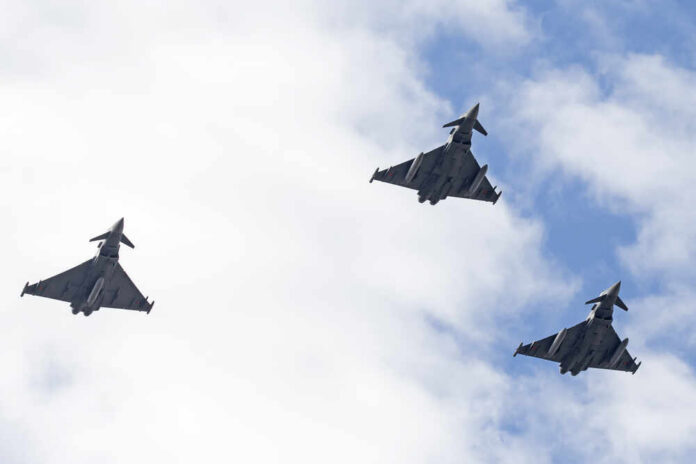
French fighter jets participating in the North Atlantic Treaty Organization’s Baltic air policing mission shot down a drone after it entered Latvian airspace from Russian territory, forcing local authorities to sound air-raid style alerts in several eastern municipalities.[1][2][3][5] Latvian National Armed Forces publicly announced that allied jets “successfully shot down a drone” that had violated the country’s airspace, marking the first time such an unmanned aircraft has been destroyed over Latvia itself.[1][3] The emergency alert was later lifted once the aircraft was downed and the immediate threat contained.[1][3]
Reports indicate the French Rafale fighters took off from Šiauliai air base in neighboring Lithuania, where they are deployed as part of NATO’s long-running Baltic Air Policing mission to protect the skies of Latvia, Lithuania, and Estonia.[1][2][3][5] The drone was detected over Latvia’s Latgale region in the east, close to the border with Russia, prompting what local media described as an “orange” alert level and warnings in multiple municipalities near the frontier.[1][3] After the interception, authorities stressed that airspace security had been restored, but they also tied the incident to continuing Russian aggression in the region.[1][3]
Russian Electronic Warfare And The Gray-Zone Threat
Latvian officials say preliminary assessments suggest the drone entered the country’s airspace due to the impact of Russian electronic warfare systems operating across the border, a reminder that Moscow is using more than tanks and artillery to pressure its neighbors.[1][2] The Latvian army stated that the drone came from Russia “as a result of Russian electromagnetic warfare,” while still stopping short of naming who actually launched or controlled the platform.[2] Public reporting so far does not describe any payload, mission, or confirmed operator, leaving open whether this was a weapon, a lost asset, or a probe of NATO’s defenses.[1][2][3][5]
Even with those gaps, the pattern fits a broader trend in the Baltic region, where drone incursions and unexplained explosions have become part of the background noise of a grinding conflict next door.[4] Earlier in the year, suspected stray Ukrainian drones, likely knocked off course in cross-border attacks, entered Latvia from Russia and even exploded at an oil facility, underscoring how crowded and chaotic the airspace has become along NATO’s eastern edge. Each incident may look small on its own, but the cumulative effect is constant pressure on border states and a steady test of allied response times and rules of engagement.[4]
Why This Matters For Americans And Constitutional Conservatives
For American readers who care about national sovereignty and a strong, constitutional republic, the shootdown over Latvia is a warning about what happens when adversaries exploit every seam in the system—borders, airspace, and even the electromagnetic spectrum.[1][2][3][5] NATO’s quick interception shows that when allied forces are given clear missions, robust funding, and freedom to act, they can defend territory without waiting for bloated international bureaucracies or timid career diplomats to catch up.[2][3][5] That is exactly the kind of decisive posture many conservatives have long demanded at America’s own borders, where unmanned systems, cartel drones, and unknown aircraft increasingly test federal resolve.
NATO has scrambled French fighter jets in Latvia to shoot down a drone that entered its airspace from Russia.Latvia issued an air threat alert and urged locals to take shelter after the UAV from Russia breached their airspace, a military spokesperson said.https://t.co/mvNTWUvzAJ
— Charmian (@o_charmian29763) June 8, 2026
The unanswered questions around this drone—who owned it, what it carried, whether it was a deliberate provocation or collateral from another battlefield—also highlight the dangers of sleepwalking through defense debates at home.[1][2][5] Russian electronic warfare can push a drone accidentally into NATO skies today; tomorrow, a more capable system could target energy infrastructure, communications networks, or critical bases if deterrence weakens.[1][2][4] As Washington wrestles with budgets, foreign entanglements, and woke distractions, incidents like this remind constitutional conservatives that the first job of any federal government is defending its people, its territory, and its allies—not appeasing hostile regimes or funding ideological experiments.
Sources:
[1] Web – French NATO jets shoot down stray drone in Latvia
[2] Web – French NATO jets shoot down drone in Latvian airspace, alert lifted
[3] Web – NATO Fighter Jets Shoot Down Drone in Latvia
[4] Web – French fighter jet shoots down Russian drone in NATO airspace
[5] Web – NATO fighters shoot down drone in Latvia for the first time | УНН