
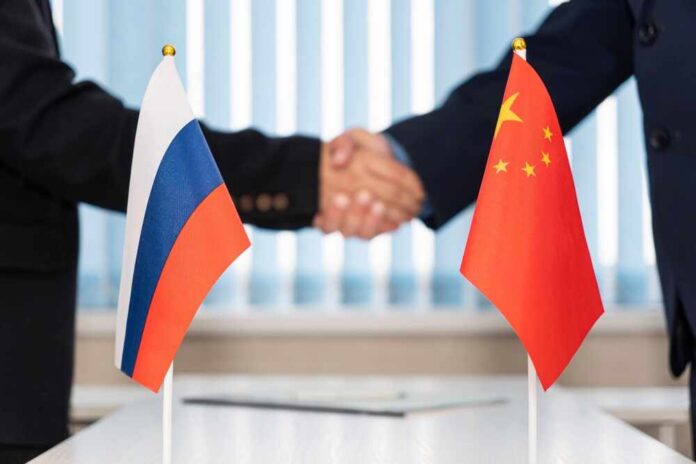
When China and Russia loudly promised a new “multipolar world order,” they delivered a headline for the history books but almost no hard plan for how, or when, anything will actually change.
Story Snapshot
- The joint declaration talks big about a “multipolar world” but offers vague principles instead of timelines, budgets, or enforcement tools.
- Analysts say the Xi–Putin summit showcased political theater and shared grievance more than a concrete blueprint to replace U.S.-led institutions.
- Beijing and Moscow still compete, rely on the existing global system, and signed mostly routine economic and security deals on the sidelines.
- For Americans distrustful of global elites, the episode shows how great powers sell “new orders” in speeches while quietly keeping the old one that benefits them.
What China and Russia Actually Signed — Lofty Words, Few Instructions
The 20 May document is grandly titled the “Joint Declaration of the Russian Federation and the People’s Republic of China on the Establishment of a Multipolar World and a New Type of International Relations,” but its core is broad political language, not a step‑by‑step program.[3][4] The text leans on concepts such as sovereign equality, indivisible security, and democratisation of international relations, echoing United Nations Charter phrasing while avoiding concrete benchmarks, timelines, or institutional blueprints.[3][4] Experts at the Toda Peace Institute argue that the declaration “matters less for what it promises than for what it reveals,” because the real action is in how Moscow and Beijing try to seize the language of legitimacy at a time when trust in the United Nations has weakened.[3] That kind of careful wording may sound impressive on television, but it leaves citizens on all sides guessing what, if anything, will materially change in their daily lives.
Commentary from policy analysts underscores that the summit was largely about signaling and image rather than building a new world government from scratch.[3][4] Chatham House describes the China–Russia relationship as a “pragmatic alignment rather than full alliance,” stressing that the meeting was “designed to send a message to the world” more than to launch an integrated bloc.[4] Researchers at the German Institute for International and Security Affairs note that similar declarations go back at least to 1997, when both sides already pledged to promote “multipolarisation of the world,” meaning the latest statement follows a familiar script rather than marking a sudden break. In practice, this continuity suggests a pattern of repeated “new order” rhetoric that slowly shifts norms but rarely comes with the kind of binding commitments or accountability that ordinary Americans would recognize from a serious business contract or domestic law.
Strategic Partnership: Alignment of Grievances, Not a Formal Anti‑U.S. Alliance
Behind the grand talk, the China–Russia relationship remains driven by cold, pragmatic interests and shared resentments about Western dominance, sanctions, and criticism of their regimes.[2][4] ETH Zurich research characterizes “shared views on world order” and a desire to weaken United States influence as important drivers of the partnership, but also emphasizes that each side still jealously guards its own autonomy.[2] The German analysis similarly describes their vision as using the partnership as a “counterweight to the United States and the Western liberal order,” yet without the dense institutions or mutual defense guarantees that mark true alliances. Chatham House underlines that “both sides benefit from appearing united,” especially when they feel under pressure from Washington and European capitals, but warns that their cooperation has clear limits.[4] For citizens in America and Europe who suspect that global elites coordinate behind closed doors, this is a reminder that even authoritarian powers struggle with trust and turf battles when they try to reshape the system that enriches them.
The Beijing summit agenda itself looked more like hard‑nosed bargaining than the birth of a new empire. An IPS interview notes that the meetings focused on two main items: economic issues, especially the stalled Power of Siberia 2 gas pipeline, and the political declaration on multipolarity, while “everything else was routine Russian-Chinese diplomacy.” Reporting on the visit describes more than twenty signed documents touching on artificial intelligence, energy, currency settlement, and military exercises—real but incremental deals that fit a long trend of deeper bilateral cooperation. South China Morning Post coverage stresses that Vladimir Putin left without concrete wins on the pipeline, highlighting how China’s stronger economic position lets it extract benefits while avoiding costly commitments.[2] This pattern fits what many Americans already feel about international summits: leaders issue flowery communiqués about peace and justice, then haggle over pipelines, trade routes, and market access once the cameras turn away.
Why This Matters for Americans Disillusioned With the Global System
For conservatives and liberals alike who view the current global order as rigged by unaccountable elites, the Sino‑Russian declaration reveals a troubling but familiar reality: rival great powers talk about defending sovereignty and fairness, yet they are trying to bend the same system to their advantage rather than replace it with something truly representative.[2][3] The Toda analysis points out that Russia and China are competing to claim they are the “more authentic defenders” of the United Nations Charter, even as many of their actions—from Ukraine to internal repression—undercut those principles.[3] ETH Zurich’s work describes their joint challenge as “illiberal,” aimed at limiting Western influence without expanding individual freedoms or transparency for their own citizens.[2] For Americans who already fear that the “rules‑based order” never really protected blue‑collar jobs, stable energy prices, or border security, this contest over who gets to speak for international law may feel like elites arguing over the rulebook of a game ordinary people keep losing.
The bigger risk is that dramatic language about a “new world order” distracts from the concrete ways global power politics are failing everyday people in all three countries.[2][4] Research on the Sino‑Russian partnership shows that while leaders on both sides promise a more “just and equitable” order, their cooperation has not reversed widening inequality, corruption, or the squeeze on middle‑class living standards.[2] Chatham House notes that China remains cautious about being dragged into Russia’s wars or economic troubles, because its main priority is sustaining growth inside an economy that still depends heavily on the very Western markets and technologies it criticizes.[4] For Americans watching from home, this episode is a reminder to look past dramatic summit slogans and judge all governments—ours and theirs—by a simple measure: are they using their power to make life more secure, affordable, and free for their citizens, or just rearranging the chairs at the same global table while ordinary families pay the bill?
Sources:
[2] Web – [PDF] China, Russia, and the Future of World Order
[3] Web – China and the Building of a New–and Illiberal–World Order through …
[4] Web – China and Russia’s strategic duo endures – but its limits are clear