
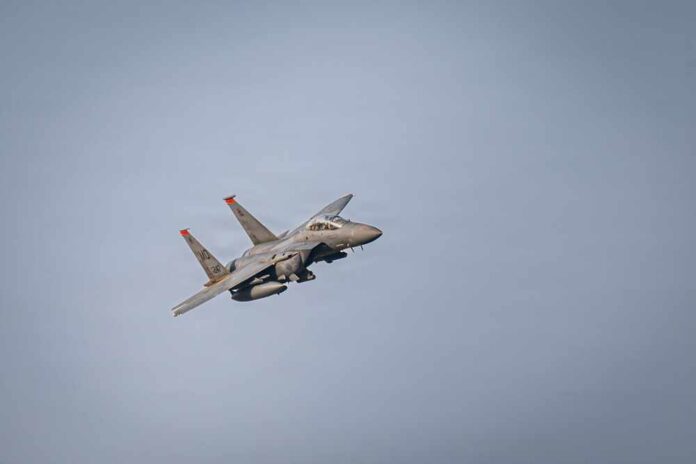
A U.S. F‑15E shot out of the sky over Iran by what officials say was likely a cheap Chinese missile is the kind of wake‑up call that should end every illusion about Beijing, Tehran, and American air superiority.
Story Snapshot
- U.S. officials say the F‑15E over southwestern Iran was likely brought down by a Chinese-made shoulder-fired missile.
- Reports suggest China may also have supplied Iran with a powerful long-range radar to spot advanced U.S. aircraft.
- The Pentagon has not released forensic proof, underscoring how much of this war is being fought in the shadows.
- The incident exposes years of complacency about Chinese–Iranian military ties and the risks to U.S. forces.
What U.S. Officials Are Saying About The F‑15E Shootdown
NBC News, as summarized by multiple outlets, reports that three U.S. officials familiar with the investigation say the F‑15E Strike Eagle shot down over southwestern Iran in April was likely hit by a Chinese-made shoulder-launched missile, a man-portable air defense system.[1][3] This shootdown marked the first time in decades that an American fighter jet has been lost to enemy fire, and both crew members ejected and were rescued after a tense search in Iran’s Zagros Mountains.[1][3]
Reports relay that the missile believed to have downed the jet was a portable surface-to-air system roughly two meters long and under twenty kilograms, designed to target low-flying aircraft.[1][3] Such systems are relatively inexpensive, easy to move, and difficult to detect until they are fired, which makes them ideal tools for regimes and proxy forces that want to challenge U.S. airpower without fielding large, visible air defense networks. U.S. officials are still investigating the circumstances and have not released technical details.[1][2][3]
China’s Suspected Role: Missiles, Radar, And Quiet Support To Iran
According to coverage of the NBC investigation, U.S. sources believe Iran likely used a Chinese-made man-portable missile, with some reports specifically pointing to a Chinese system such as the FN‑6, to bring down the F‑15E.[3] Army-focused reporting notes that investigators are examining whether a Chinese-made portable air defense system was responsible, but emphasizes that the Pentagon and United States Air Force have not publicly identified the exact weapon, leaving key details classified or unresolved.[4]
Beyond the missile itself, U.S. officials cited by these reports say China may have provided Iran with a long-range YLC‑8B early-warning radar able to detect advanced or stealth aircraft, potentially including platforms designed to evade traditional radar coverage.[1][3] This radar, if deployed, would significantly improve Iran’s ability to track U.S. and allied aircraft at distance, creating a more lethal environment for American pilots and giving Tehran more confidence to challenge U.S. operations across the region.[1][2][3]
Fog Of War: What We Know, What We Do Not, And Why It Matters
Despite the strong language about a likely Chinese-made missile, the public record still lacks a recovered missile body, serial-number trace, or official forensic attribution released by the Pentagon.[4] Army-centered analysis explicitly notes that U.S. Defense Department officials have not publicly confirmed the specific system used, and that much of what is known comes from anonymous sources rather than completed forensic work that can be shown to the American people.[4] That gap reflects both operational secrecy and the difficulty of recovering evidence deep inside hostile territory.
Reports describing possible Chinese radar assistance also stress that it remains unclear whether the YLC‑8B or similar system was actually deployed and operating at the time of the shootdown.[1][2][3] One U.S. official familiar with the discussions told NBC that any Chinese assistance, while troubling, had little practical effect on the battlefield, suggesting that Iran’s capabilities still depend heavily on its own crews and doctrine rather than foreign magic weapons.[1] At the same time, the Chinese Embassy’s response insists that Beijing acts “prudently and responsibly” on arms exports and rejects what it calls “groundless smear,” highlighting how Beijing tries to deny involvement while U.S. officials flag the risks.[1]
What This Means For U.S. Power, China, And Iran Going Forward
The downing of a front-line American F‑15E with a relatively low-cost, man-carried missile underscores how adversaries can chip away at U.S. dominance using compact systems and foreign partnerships instead of massive armies.[1][3] U.S. intelligence had reportedly tracked preparations for new Chinese air defense deliveries to Iran even before this incident, suggesting a pattern rather than a one-off transfer and reinforcing long-standing concerns about an emerging Beijing–Tehran military pipeline.[3] Every such transfer increases the danger to U.S. pilots and complicates any future operations to deter or punish Iran.
Sources tell NBC News the US F-15E Strike Eagle shot down last month over SW Iran was likely hit by a Chinese-made FN-6 man-portable surface-to-air missile held by Iranian forces. A rescue op recovered the pilot and weapons systems officer pic.twitter.com/qEIahInsF8
— ZbarOps (@ZbarOps) May 30, 2026
This episode also illustrates how both Washington and Beijing operate in a gray zone where attribution is murky and public confirmation lags behind classified assessments.[1][2][3][4] For U.S. officials, tying the loss of the jet to Chinese-made hardware supports pressure for tighter export controls, sanctions, and greater scrutiny of Chinese technology flows into the Middle East.[1][3] For China, denying responsibility helps preserve its image while reaping the strategic benefits of arming an American adversary, leaving U.S. forces to bear the risks in an increasingly crowded and hostile airspace.[1][2][3]
Sources:
[1] Web – Iran may have used Chinese missile to shoot down U.S. fighter jet…
[2] Web – US report: Fighter jet downed in Iran in April hit by Chinese-made …
[3] Web – Iran likely used Chinese-made missile to down US F-15: Report
[4] Web – Iran may have shot down a U.S. F-15 with a Chinese missile