
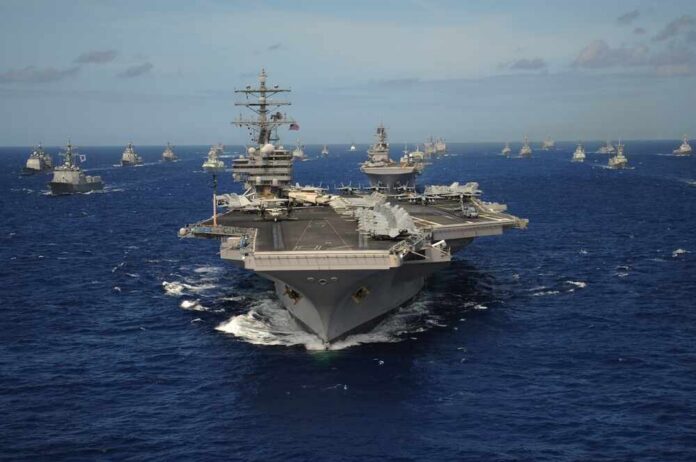
China has spent decades building one weapon system designed to do one thing — keep U.S. Navy aircraft carriers too far away to matter in a Pacific war.
At a Glance
- China’s long-range anti-ship missiles are designed specifically to punch through carrier strike group defenses, and U.S. government analysts confirm the threat is real.
- Each U.S. Navy destroyer carries a limited number of interceptor missiles, creating a “magazine depth” problem when facing large missile salvos.
- The Navy is testing a new hypervelocity projectile that could add hundreds of low-cost interceptors to each ship without replacing expensive missiles.
- Experts disagree on how dangerous the threat truly is — carriers are hard to find and track, and their layered defenses remain formidable.
China Builds a Wall the Navy Can’t Easily Cross
China has spent years building what military planners call an anti-access/area-denial system — a network of long-range missiles, radars, and satellites designed to keep enemy ships far from its shores. The core of this strategy targets U.S. aircraft carriers. The Congressional Budget Office confirms that China is fielding cruise missiles and anti-ship ballistic missiles specifically “to penetrate the air defenses of carrier strike groups.” [7] That is not speculation. It is an official U.S. government finding.
The logic behind China’s strategy is simple. A U.S. carrier strike group is enormously powerful, but it can only project air power within roughly 500 miles. China’s anti-ship missiles can fly much farther. If China can force carriers to stay outside that range, the carrier’s aircraft become useless in a Taiwan conflict. That is the trap Beijing has been building for three decades.
The Missile Math Problem Facing Every Destroyer
A carrier strike group’s main defense against incoming missiles sits inside the Mark 41 Vertical Launch System — a set of cells on each escort ship that holds interceptor missiles. Arleigh Burke-class destroyers carry a maximum of 96 cells. Ticonderoga-class cruisers carry up to 122. [2] Those cells hold a mix of weapons — air defense missiles, land-attack cruise missiles, and anti-submarine weapons — not just interceptors. Once those cells are empty, the ship cannot reload at sea.
That creates what analysts call a magazine depth problem. China could fire a large salvo of cheap missiles to exhaust the defenders’ interceptors, then send a second wave at the now-defenseless carrier. Naval analysts have warned for years that “defenses at sea are never perfect” and that the attacker has physics, numbers, and time on their side. [22] A carrier’s defense must be flawless. An attacker only needs to get lucky once.
A Cheaper Fix Already Being Tested at Sea
The Navy is not sitting still. Engineers are testing a new weapon called the Hypervelocity Projectile — a guided round fired from the standard Mk 45 five-inch deck gun already found on nearly every U.S. warship. The Navy and the Pentagon’s Strategic Capabilities Office first tested it aboard USS Dewey in 2018, firing 20 rounds during the Rim of the Pacific exercise to prove it could knock down cruise missiles and large drones. [10] The gun’s high rate of fire and large ammunition storage make it a natural fit for defeating missile swarms.
The numbers are striking. Each hypervelocity round costs roughly $75,000 to $100,000 — compared to $1 million or more for a standard interceptor missile. [10] Fielding them on destroyers could add up to 600 additional interceptors per ship for air defense missions without using a single precious launch cell. [12] The Navy resumed at-sea testing in 2024, and BAE Systems reports the round has “successfully demonstrated effects on a various number of airborne threats.” [12] That is real progress, though the weapon is still in testing and not yet fully fielded.
Is the Threat Overstated? The Other Side of the Debate
Not every analyst agrees carriers are in serious danger. A 2020 Forbes analysis argued that vulnerability claims are greatly exaggerated. Carriers move constantly and nuclear power gives them unlimited range, making them extremely hard to track across the vast Pacific. China would need more than a hundred low-orbit satellites coordinated with long-range missiles and a fast command system to reliably find and hit a moving carrier. [19] As of this writing, China does not fully possess that capability.
The honest answer is that both sides of this debate have merit. Carriers are the best-defended surface ships in the world. But “best defended” and “safe enough to risk losing” are two different standards. Losing a nuclear-powered carrier — with thousands of sailors aboard — would be a catastrophic blow to American power and prestige. That is why the Navy is right to take the threat seriously and push hard on solutions like the hypervelocity projectile, even if the worst-case scenario never comes to pass. America’s military strength depends on staying ahead of the threat, not catching up to it.
Sources:
[2] Web – Vertical Launching System VLS Mk 41 – BAE Systems
[7] Web – Do any aircraft carriers carry Vertical Launch Systems(VLS) cells?
[10] Web – MODULE 2—CARRIER BATTLEGROUP & Amphibious Ready …
[12] Web – Hypervelocity Projectile (HVP) – BAE Systems
[19] Web – [PDF] What it takes to successfully attack an American Aircraft …
[22] YouTube – Are Aircraft Carriers Becoming Obsolete? – The Red Line Podcast