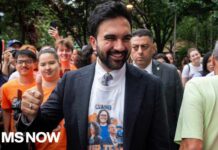


Birthright citizenship is not a loophole “legalizing an invasion of America”; it is a deliberate constitutional guarantee, reaffirmed again and again by the courts as the core mechanism by which the United States defines and renews its political community.
Key Points
- The Supreme Court has reaffirmed that the Fourteenth Amendment guarantees citizenship to nearly everyone born on U.S. soil, with only narrow, longstanding exceptions.
- Efforts by President Trump to end or narrow birthright citizenship by executive order were struck down as unconstitutional, closing off the path of unilateral presidential change.
- Critics like Carl Higbie cast birthright citizenship as “rewarding lawbreakers,” but they offer political rhetoric, not legal or historical evidence that contradicts the Court’s reasoning.
- More than a century of precedent, from *Wong Kim Ark* to modern cases, treats children of immigrants—including the undocumented—as fully “subject to the jurisdiction” of the United States.
- Changing birthright citizenship would require a constitutional amendment or a radical break from settled doctrine—far beyond any short-term policy response.
The Constitutional Architecture of Birthright Citizenship
To understand why the Supreme Court rejected Trump’s attempt to end birthright citizenship and why claims like Carl Higbie’s do not carry legal weight, you have to start with the Fourteenth Amendment’s Citizenship Clause. Ratified in 1868, it states that “All persons born or naturalized in the United States, and subject to the jurisdiction thereof, are citizens of the United States.” This language was crafted in the shadow of the Dred Scott decision, with a clear purpose: to settle, once and for all, that the nation’s membership is defined by birth on its territory or lawful naturalization, not by race, status, or the grace of any particular majority.
From the moment of adoption, Congress and the courts understood this clause as a broad, almost universal rule. It was reinforced by the Civil Rights Act of 1866, and then interpreted in a series of cases in the late nineteenth century, culminating in *United States v. Wong Kim Ark* in 1898. There, the Supreme Court held that a man born in San Francisco to Chinese nationals who were themselves barred from naturalization was nonetheless a citizen by birth. Justice Horace Gray’s opinion famously described the “ancient and fundamental rule” of citizenship: anyone born in the United States and subject to its laws is a citizen, with very narrow exceptions for children of foreign sovereigns, diplomats, hostile occupying forces, and certain tribal members.
“Subject to the Jurisdiction”: What the Phrase Actually Means
Modern controversy, including Trump’s executive order and Higbie’s commentary, turns on the phrase “subject to the jurisdiction thereof.” Critics insist that this language allows the government to exclude children of undocumented immigrants or temporary visitors, arguing that these parents owe allegiance elsewhere and lack lawful domicile. But that reading collides with more than a century of judicial interpretation. In *Wong Kim Ark*, the Court squarely rejected the idea that parental nationality or legal status strips a U.S.-born child of citizenship if the parents are resident and subject to American law.
Subsequent decisions and federal guidance have treated “subject to the jurisdiction” as a straightforward functional test: are you subject to U.S. law—arrestable, suable, punishable—when you are on U.S. soil? Undocumented immigrants clearly are. They can be prosecuted, taxed, and deported, all mechanisms of jurisdiction. That is why the Court in *Plyler v. Doe* recognized undocumented children as persons entitled to constitutional protections, including education, precisely because they fall under U.S. legal authority. When Chief Justice Roberts and the modern Court revisit this phrase, they do so against that backdrop, reaffirming that nearly everyone born here, regardless of parental status, is within the scope of the clause.
Trump v. Barbara: Why the Executive Order Failed
President Trump’s executive order attempted to redraw this settled map. On his first day back in office, he signed an order limiting birthright citizenship to children with at least one U.S. citizen or permanent resident parent. Federal district courts around the country issued injunctions, finding the order incompatible with the Citizenship Clause and existing Supreme Court precedent. When the case—styled *Trump v. Barbara*—reached the Supreme Court, the key question was not immigration policy in the abstract; it was whether the president can unilaterally reinterpret the Constitution and erase a longstanding constitutional right.
The Court said no. In a closely watched decision, Chief Justice Roberts, joined by the Court’s liberal bloc and Justice Amy Coney Barrett, held that the Fourteenth Amendment guarantees citizenship to essentially all children born on U.S. soil, save for the traditional, narrow exceptions. The majority leaned heavily on *Wong Kim Ark*, emphasizing that “that precedent is still our precedent and it is the law of the land.” The opinion underscored that neither an executive order nor ordinary legislation can rewrite a constitutional guarantee; only a new amendment or a dramatic, explicit reversal by the Court itself could do that.
Dissenting justices—Thomas, Alito, Gorsuch—argued that the framers’ original intent was narrower and that “subject to the jurisdiction” should exclude children of people here unlawfully or temporarily. Their view draws on a minority strand of originalist scholarship that emphasizes allegiance and domicile. But they offered no new historical evidence overturning the understanding that emerged in the Reconstruction era debates and in *Wong Kim Ark*, where Congress and the Court deliberately rejected language that would have carved out immigrants’ children from citizenship.
Carl Higbie’s Critique: Rhetoric Versus Law
Carl Higbie steps into this debate from a media perch rather than a judicial bench. On his Newsmax “FRONTLINE” segments and social media reels, he argues that granting citizenship to children of undocumented parents “rewards lawbreakers” and cheapens something “as precious as U.S. citizenship.” He has suggested that, if the Court upholds birthright citizenship, the Trump administration should prioritize deporting pregnant undocumented women to prevent future citizen children, framing this as a necessary response to an “invasion.”
That rhetoric resonates with some viewers, particularly those who see immigration primarily through a lens of border security and scarcity. But it does not answer the constitutional question. Higbie does not engage the text of the Fourteenth Amendment, the history of Reconstruction, or the controlling case law from *Wong Kim Ark* onward. He does not offer archival evidence showing that the framers intended to exclude children of unauthorized migrants—unsurprising, as the modern category of “illegal immigrant” did not exist in 1868 in anything like its current form. Nor does he grapple with the reality that every federal court to review Trump’s order found it unconstitutional even before the Supreme Court weighed in.
Higbie’s own public record further complicates his authority on this question. He resigned from a Trump-appointed post at AmeriCorps after a review surfaced racist, sexist, and anti-Muslim statements, raising questions about whether his immigration commentary is grounded in legal analysis or in broader cultural animus. That history does not, by itself, invalidate his concerns about policy. It does, however, underscore why his “invasion” framing belongs to the realm of political messaging, not constitutional interpretation.
Is Birthright Citizenship a “Magnet” for Illegal Immigration?
Behind Higbie’s claim that the Court is “legalizing an invasion” lies a policy intuition: if citizenship comes automatically with birth, people may be more likely to come illegally, hoping for a citizen child and a foothold. This “magnet” argument is politically potent, but the empirical picture is more complex. Research into immigration flows shows multiple drivers—economic opportunity, violence and instability in origin countries, existing family networks, and U.S. labor demand—all of which matter at least as much as legal status rules at birth.
Moreover, birthright citizenship does not automatically legalize parents. A U.S.-born child cannot sponsor a parent for legal status until adulthood, and even then, many parents are barred by other provisions of immigration law. In the meantime, families live with the risk of deportation, fragmented households, and significant economic precarity. Attorney Diana Estrada, herself a birthright citizen whose family was deported, points out that undocumented households nonetheless pay tens of billions of dollars annually in federal, state, and local taxes—contributing to Social Security and Medicare systems they cannot access.[American Immigration Council data summarized in ABC segment] That reality cuts against the simplistic picture of families “gaming” the system without obligations or costs.
What Real Change Would Require
If Congress or a future president shares Higbie’s goal of ending or severely narrowing birthright citizenship, what would it take? The legal consensus is clear: any attempt to do so by statute or executive order would violate the Fourteenth Amendment. The American Immigration Council’s synthesis is blunt: the only lawful paths are either a new amendment—requiring two-thirds of both houses and ratification by three-fourths of the states—or a radical departure by the Supreme Court from its own precedent.
Both are heavy lifts. Polling indicates strong overall public support for birthright citizenship, with roughly seventy percent of Americans favoring the current rule, even as a bare majority of Republicans express interest in adding conditions.[CBS data summarized in network coverage] Constitutional amendments on contentious social issues are rare in modern times, and revolutions in Supreme Court doctrine that overturn century-old precedents tend to be slow, contested, and institutionally costly. The Court’s rebuke of Trump’s order signals that, for now, a majority of justices see birthright citizenship not as a policy preference but as a bedrock commitment woven into the post–Civil War constitutional settlement.
"‘We keep that promise today’" — Minnesota Star Tribune
By @AbbieVanSickle@StarTribune — Wednesday 1 July 🔍The paper frames the Supreme Court ruling as a reaffirmation of a long-standing constitutional principle, highlighting the judicial rejection of an executive challenge… pic.twitter.com/vZyiHAJwTX
— Paperboy (@frontpagestoday) July 1, 2026
Citizenship, Allegiance, and the Future of the Debate
There is a deeper philosophical disagreement under all of this. Higbie and likeminded critics treat citizenship as a scarce reward to be bestowed only on those whose parents obeyed immigration rules. The Reconstruction framers, and the modern Court following them, treat citizenship by birth as the basic, non-negotiable starting point for belonging in the American polity—especially for people historically denied it. For them, the risk to the nation is not that too many babies become citizens, but that the government might once again draw lines around race, origin, or status to exclude people born under its authority.
The phrase that recurs in both nineteenth-century debates and modern opinions is allegiance. The law asks: where are you born, and to which state’s laws are you in fact subject? For a child born in Texas or Ohio to undocumented parents, the answer is straightforward: that child can be arrested, tried, and punished under U.S. law. That is allegiance enough. Calling this “legalizing an invasion” obscures the reality that these children are not foreign soldiers but neighbors, classmates, and, ultimately, voters. The Constitution’s choice to welcome them as citizens is not a glitch; it is part of how the United States has continually renewed itself in the face of demographic and political change.
Sources:
npr.org, pbs.org, cfr.org, aclu.org, news.wttw.com, instagram.com, facebook.com, youtube.com, wral.com, fam.state.gov, camden.rutgers.edu, constitutioncenter.org, lettersandsciencemag.ucdavis.edu, americanimmigrationcouncil.org